| Quick Answer: What Is Opportunity Qualification in Government Contracting? Opportunity qualification, in government contracting is the process of evaluating whether a specific federal bid is worth pursuing before committing proposal development resources. It assesses a contractor’s competitive position, past performance alignment, pricing viability, and agency relationships to determine whether pursuing the opportunity is likely to result in a win. |
Federal contractors face a common problem: too many opportunities, not enough resources to pursue them all. Opportunity qualification in government contracting is the process of evaluating whether a specific bid is worth pursuing before committing proposal development time and budget to it.
Done well, opportunity qualification protects your business development resources, sharpens your competitive positioning, and improves your overall win rate. Done poorly, or skipped entirely, it leads to wasted proposals, demoralized teams, and thin margins.
Understanding how to build a systematic qualification process starts with understanding what the federal capture planning process actually looks like before a solicitation drops.
Why Opportunity Qualification Matters in Federal Contracting
The federal procurement market is large and competitive. Solicitations covering everything from IT services to construction to professional services are posted to SAM.gov continuously. Not every opportunity is a fit, and not every fit is winnable.
Pursuing the wrong opportunities is expensive. A full proposal response for a complex federal contract can require significant internal time from business development staff, technical subject matter experts, pricing analysts, and management. If your company is not competitive, because of incumbency, past performance gaps, or a weak price position, that investment is unlikely to pay off.
Opportunity qualification exists to answer one question before any of that work begins: should we bid this?
What Is Opportunity Qualification?
Opportunity qualification is a structured evaluation of a specific federal procurement opportunity against your company’s capabilities, competitive position, and strategic priorities. It typically happens during the pre-RFP phase, after a Sources Sought notice, Request for Information (RFI), or procurement forecast entry, but it should be revisited when the final solicitation is released.
A Sources Sought notice is a market research tool agencies use to identify capable contractors before issuing a formal solicitation. An RFI (Request for Information) is similar. It allows an agency to gather information about industry capabilities without committing to a procurement. Both are early signals that a requirement is forming, and both are prime windows for qualification analysis.
A qualified opportunity is one where:
- Your company has relevant, demonstrable past performance
- Your technical approach can credibly meet the stated requirements
- Your price can be competitive without destroying margins
- You have a realistic path to win based on known competitors and agency relationships
An opportunity that fails on any of these points warrants serious reconsideration before you commit to a full response.
Key Factors to Evaluate in Federal Bid Qualification
There is no universal qualification checklist, but the following factors consistently appear in sound federal bid strategy:
Past Performance Match
Federal evaluators weigh past performance heavily. If your recent contract history does not align with the scope, scale, or complexity of the requirement, your proposal starts at a disadvantage. Review the requirement against your most relevant contracts and assess whether any gaps are bridgeable through teaming.
Incumbent Advantage
Incumbents win the majority of federal recompetes. If an incumbent is performing well and has maintained strong agency relationships, the bar to displace them is high. That does not mean you should not compete, but you should understand clearly why you can win before committing to the effort.
Agency Relationships
Federal contracting decisions are made by people. Evaluators follow the solicitation, but agencies tend to award to contractors they know and trust. If you have no prior relationship with the contracting office or program office, that is a factor worth weighing honestly, even if it does not have the most weight in the calculation.
Set-Aside Eligibility
Check whether the opportunity is a set-aside. If it is restricted to 8(a) firms, HUBZone businesses, Women-Owned Small Businesses (WOSB), or Service-Disabled Veteran-Owned Small Businesses (SDVOSB), verify your eligibility before investing further. SBA.gov maintains current eligibility requirements for all small business set-aside programs.
Price-to-Win Viability
Can you price competitively and still make the contract worth performing? If your cost structure does not support the likely competitive range, that is a qualifying factor that may tip the decision. The PWIN analysis and price-to-win strategy framework helps assess this rigorously before committing to a bid.
Timeline and Capacity
Do you have the proposal development bandwidth to respond well? A weak response submitted under resource pressure is rarely better than no response at all. Capacity is a legitimate qualification factor and a place where you can get help.
A Practical Opportunity Qualification Framework
A simple go/no-go scoring model formalizes the process. Rate each factor on a consistent scale and set a threshold score below which your organization will not bid without executive sign-off.
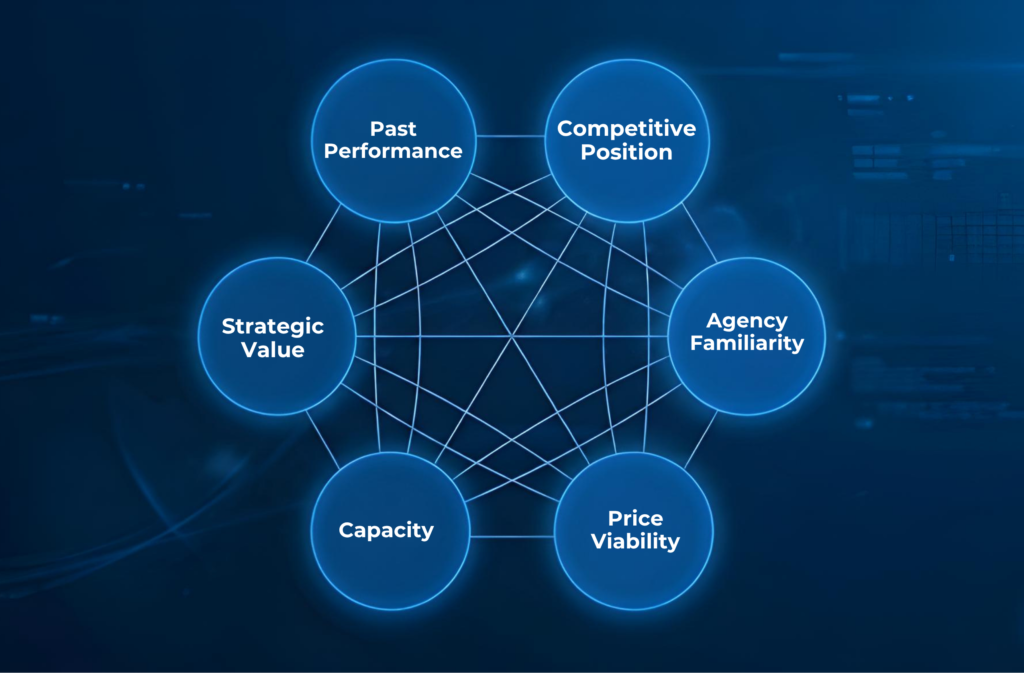
Here is a basic six-factor framework:
- Past performance alignment- How closely do your best contracts match this requirement?
- Competitive position- Do you have clear advantages over likely competitors?
- Agency familiarity- Have you engaged with this agency or program office before?
- Price-to-win viability- Can you price to win and still make the contract worth performing?
- Proposal capacity- Do you have the bandwidth to submit a competitive response?
- Strategic value- Does winning this contract advance your long-term federal contracting pipeline?
Score each factor. Discuss results with your business development and capture leadership before committing resources. Revisit your scoring when the solicitation drops, as requirements and competitive dynamics often shift between the RFI and the final RFP.
Connecting Qualification to Proposal Execution
Qualification is not the end of the process, it is the beginning of it. The factors you assess during qualification directly shape how you approach the proposal. Past performance gaps become sections to address through teaming. Competitive weaknesses become areas to neutralize through solution design. Your price position informs your staffing and subcontracting structure.
If you qualify an opportunity and decide to pursue it, the next question is whether your team has the capacity and expertise to execute a competitive response. That is where working with experienced federal proposal writing and development services can be the difference between a compliant submission and a winning one.
| Key Takeaways ● Opportunity qualification is a structured process for deciding whether to pursue a federal bid before committing proposal resources. ● Key qualification factors include past performance alignment, incumbent advantage, agency relationships, set-aside eligibility, price-to-win viability, and proposal capacity. ● A simple scoring model applied consistently across opportunities improves BD resource allocation and overall win rates. ● Qualification findings should directly shape your proposal strategy and gaps identified early can often be addressed through teaming or solution design. ● Revisit your qualification assessment when the final RFP drops, since requirements and competitive dynamics frequently change between the RFI and solicitation. |
Work With a Federal Proposal Team That Wins
Whether you have an RFP in hand today or you are building your federal strategy for the year ahead, SAS-GPS is ready to help. We provide end-to-end proposal development, compliance review, and pricing support for federal contractors across all industries.
Learn more about our government proposal writing services or contact our team to discuss an active opportunity.
Sources
SAM.gov — Federal contract opportunities and procurement notices: https://sam.gov
SBA.gov — Small business set-aside programs and eligibility: https://www.sba.gov/federal-contracting
Federal Acquisition Regulation (FAR) — Acquisition.gov: https://www.acquisition.gov