Winning government contracts is more competitive than ever. Agencies expect contractors to meet requirements, deliver innovation, mitigate risks, and prove long-term value. For experienced contractors, the basics are no longer enough. To consistently boost your government bid win rate, you must deploy advanced strategies that start long before a government RFP is released and continue even after a proposal is submitted.
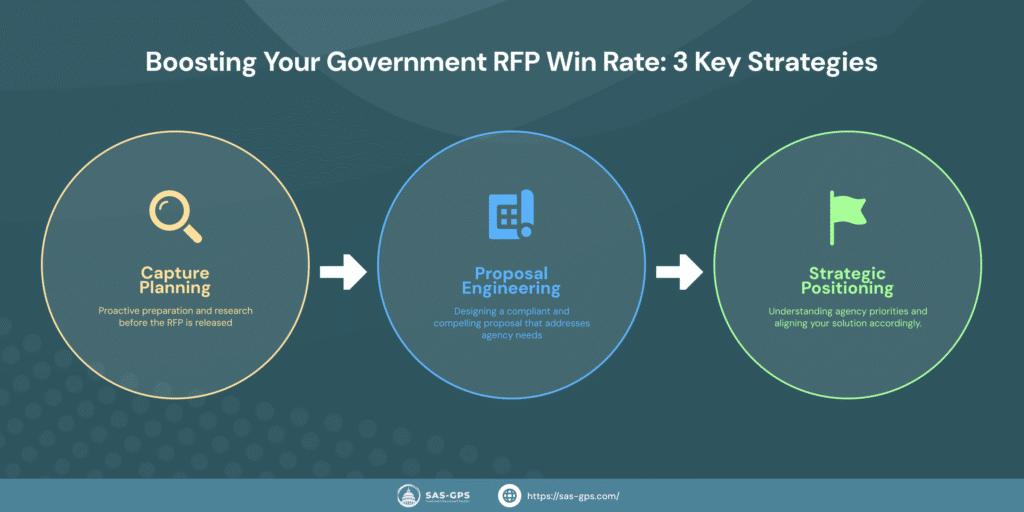
This article explores high-level techniques—rooted in capture planning, proposal engineering, and strategic positioning—that separate top performers from the rest. Whether targeting federal, state, or local opportunities, these methods will help you drive higher win rates and achieve sustainable growth.
Stay Aligned with Shifting Agency Priorities
Government agencies do not operate in a vacuum. Their priorities evolve in response to legislative mandates, leadership changes, budget constraints, and global events. Contractors who understand and anticipate these shifts can position themselves far more effectively.
For example, cybersecurity has risen sharply in federal solicitations, with initiatives like Zero Trust Architecture (ZTA) being mandated across departments. Similarly, many agencies now emphasize sustainability and small business participation.
To stay aligned:
- Monitor agency forecasts and strategic plans (available on agency websites and SAM.gov).
- Attend industry days and agency-specific outreach events to hear firsthand from program managers.
- Subscribe to relevant news feeds covering legislation, procurement reform, and agency budget hearings.
Understanding the “why” behind an RFP allows you to shape solutions that resonate beyond the technical scope, increasing your evaluation scores in areas like “understanding of requirements” and “proposed approach.”
Pro Tip: Create agency-specific briefing books for your business development teams, summarizing missions, challenges, leadership changes, and spending trends.
Build an Aggressive Pre-RFP Capture Process
The pre-RFP phase is where a large portion of the battle is won. You’re behind your competition if you’re only reacting to issued solicitations.

Elements of an aggressive capture process include:
- Early identification: Use tools like GovWin IQ, Bloomberg Government, and agency forecasts to spot opportunities 3 months out.
- Direct engagement: Schedule capability briefings with program managers before procurements are finalized. Share solutions tailored to their evolving challenges.
- RFI and Sources Sought excellence: Treat these as “soft competitions.” Well-crafted responses can influence the final RFP and position your firm favorably.
- Solution shaping: During market research, offer innovative ideas agencies can incorporate into RFPs, ideally favoring your company’s unique strengths.
An aggressive capture process helps you gather inside knowledge—budget, incumbent performance, hot buttons—that your competitors may not have.
Assemble a Purpose-Built Proposal Team
Winning complex government proposals requires the right people in the right roles—not just whoever is available. These teams may be internal or contracted through experienced firms like SAS-GPS.

Critical proposal team members:
- Capture Manager: Builds and maintains customer relationships and helps shape the solution strategy
- Proposal Manager: Oversees timelines, templates, reviews, and ensures compliance throughout the process
- Solution Architect: Develops technical and management approaches aligned with the RFP’s requirements
- Volume Leads: Subject matter experts responsible for core sections like Technical, Management, Past Performance, and Pricing.
- Editors and Graphic Designers: Refine the proposal for clarity, consistency, and visual impact
Invest in building a Proposal Asset Library to streamline your response process. Include essentials such as:
- Written sections that don’t change significantly, such as Safety Plans or Cybersecurity narratives
- Approved past performance references
- Key personnel resumes
- Certifications and awards
Having these assets readily available reduces turnaround time and improves the quality of your proposals, especially when deadlines are tight. Maintaining consistency by working with the same team over time helps ensure they understand your company’s details and can use the library effectively. If you’re partnering with a proposal support firm, confirm that they are organizing your submissions in a way that builds a usable, searchable asset library.
Action Tip: Conduct “war room” sessions where technical SMEs brainstorm differentiators and hot-button solutions specific to the opportunity.
Craft Win Themes That Speak Directly to Evaluators
Every proposal must answer two critical evaluator questions:
- Why should we select this company?
- Can they successfully deliver the work?
Generic promises like “experienced team” or “best value” fall flat. Effective win themes directly connect your solution to benefits the agency cares about, backed by evidence, not fluff.
Example of a weak win theme:
“We offer a wide range of cybersecurity services.”
Example of a strong win theme:
“By applying our DHS-tested Zero Trust security model, we reduce breach risk by 43% within 90 days.”
Steps to build winning themes:
- Analyze RFP evaluation criteria line by line.
- Identify three to five key customer pain points.
- Align differentiators to pain points with tangible outcomes (cost savings, time reduction, risk mitigation).
Clear, outcome-focused win themes increase the evaluator’s confidence and can be the deciding factor in a close competition.
Enforce 100% Compliance — and Deliver Memorable Responses.
Compliance is a minimum entry requirement for winning any government RFP. Non-compliance—missing sections, improper font sizes, late submissions—will eliminate you before the technical review.
Yet compliance does not mean boring.
Techniques to stay compliant while standing out:
- Use annotated outlines: Based on RFP instructions, detailing page limits and mandatory subsections.
- Bright graphics: Visuals like process flows, risk matrices, and milestone charts simplify complex solutions, as allowed.
- Impactful executive summaries: Speak directly to decision-makers about how your solution delivers results.
Remember: every graphic, bullet point, and paragraph should address an evaluation factor or solve a customer problem.
Action Tip: Implement a three-stage review process: Pink Team (storyline), Red Team (draft content), and Gold Team (final compliance and polish).
Use Data and Debriefs to Drive Proposal Improvements
Elite contractors treat every proposal as a data point, whether they win or lose.
How to use data to improve win rates:
- Debriefs: Always request debriefs and ask specific questions about scoring, strengths, and weaknesses.
- Win/Loss database: Maintain an internal database tracking reasons for wins and losses across customers and contract types.
- Analytics dashboards: Track proposal cycle times, compliance issues, average scoring trends, and cost per bid.
Key Metrics to Track:
- Capture ratio (number of opportunities won vs. pursued)
- Win rates by agency, customer type, and team configuration.
- Review cycle effectiveness (Red Team pass rate vs. final score)
By analyzing trends, you can make informed decisions about resource allocation, teaming, and process adjustments.
Common Mistakes Even Experienced Contractors Make
Even seasoned federal contractors can fall into costly traps that hurt their win rates. Some of the most common include:
- Chasing poorly qualified bids: Bidding long shots without a customer relationship, solution advantage, or competitive intelligence lowers overall win rates.
- Underestimating incumbents: Incumbents often have deep customer familiarity, insider knowledge, and embedded teams. To win, challengers must offer a superior solution by solving unresolved pain points, delivering more substantial value, or undercutting on price.
- Overusing templates: Reusing boilerplate content without tailoring it to the agency or opportunity makes proposals feel generic and disconnected from its mission.
- Lack of cross-functional collaboration: When technical, pricing, and management teams operate in silos, proposals miss the synergy and cohesion evaluators expect in high-scoring bids.v
Avoiding these pitfalls is essential to maintaining high win rates as competition stiffens.
Conclusion: Execute Relentlessly, Improve Continuously
Winning in government contracting takes more than well-written proposals. Success demands a disciplined capture strategy, a purpose-built proposal team, win themes that resonate with evaluators, strict compliance, and a commitment to learning from every outcome.
Contractors who consistently improve their capture planning, customer engagement, and proposal execution processes will win more often and win more valuable work.
Your government RFP win rate is not static. It directly reflects the strategies you choose, the preparation you invest, and the rigor you apply across your entire pursuit lifecycle.
Commit to executing relentlessly and improving continuously, and success will follow.
Want to win more government contracts?
SAS-GPS delivers the proven capture planning, proposal management, and compliance support you need to improve your government RFP win rate. Don’t leave your next bid to chance—reach out now and let’s build your successive win together.