Past performance isn’t just a supporting detail; it’s a deciding factor in federal contracting. Agencies rely heavily on a company’s past performance to gauge whether it can deliver on promises, handle contract complexity, and mitigate risk. For high-value contracts, where stakes are high and competition fierce, demonstrating exceptional past performance can be the key to securing the win.
Yet many companies stumble in this area. They either undersell their achievements, provide irrelevant examples, or fail to align past work to the current RFP’s scope and goals. As a result, they leave evaluation points on the table — and sometimes lose bids they were otherwise well-positioned to win.
This article examines how contractors can effectively leverage their past performance in federal proposals. We’ll break down what agencies look for, how to select and craft compelling examples, how to use teaming to expand your past performance portfolio, and how to navigate challenges when your history is limited. If you want to transform your experience into a decisive competitive advantage, read on.
1. Understand How Agencies Evaluate Past Performance
Before you can use past performance effectively, you need to understand precisely how it’s evaluated. The Federal Acquisition Regulations (FAR) provide a clear framework for this.
Under FAR Part 15, past performance is a standard evaluation factor in negotiated procurements. FAR Part 42 governs how agencies collect and maintain performance data, including Contractor Performance Assessment Reports (CPARS). Evaluators may consider several sources:
- CPARS and Past Performance Information Retrieval System (PPIRS) records.
- References from prior customers or contracting officers.
- Past contract documentation and task order records.
- Subcontractor and team member performance (if relevant).
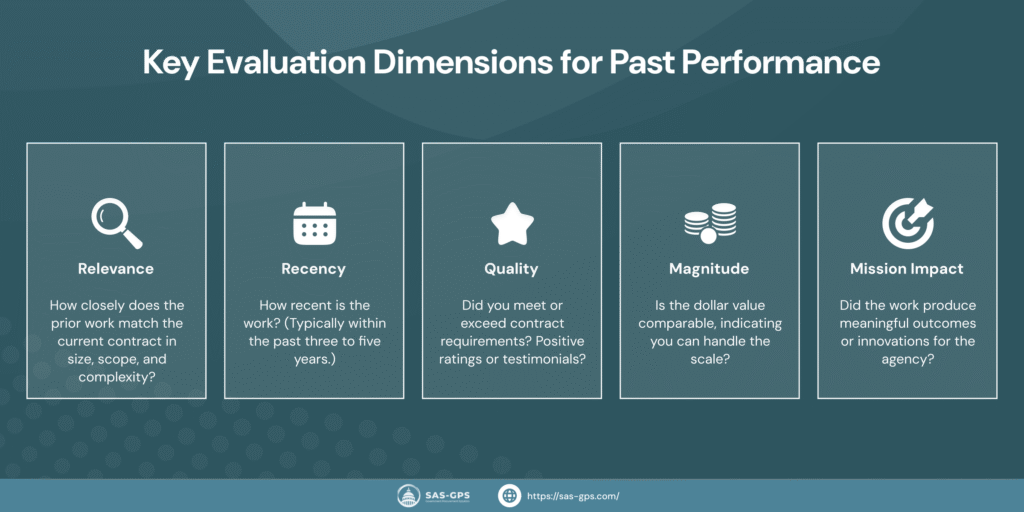
The key evaluation dimensions usually include:
- Relevance — How closely does the prior work match the current contract in size, scope, complexity, and domain?
- Recency — How recent is the work? (Typically within the past three to five years.)
- Quality — Did you meet or exceed contract requirements? Are there positive ratings or testimonials?
- Magnitude — Is the dollar value comparable, indicating you can handle the scale?
- Mission Impact — Did the work produce meaningful outcomes or innovations that benefited the agency?
Example: A software firm bidding on a Department of Homeland Security (DHS) contract shouldn’t just highlight a past project because it was large. They should underline a project where they provided DHS-relevant services, navigated similar security requirements, and delivered measurable improvements in system performance.
Many contractors misunderstand or overlook these dimensions, assuming that any “big” or “impressive” past work will carry weight. But agencies are specifically instructed to evaluate how well past performance aligns with the current contract’s goals.
Action Tips
- Read the RFP’s evaluation criteria carefully — often under Sections L and M.
- Map your past performance examples explicitly to the defined scope and priorities.
- Prepare summaries that address all five dimensions, not just project size or name recognition.
By understanding the formal and informal ways evaluators review past performance, you can prepare examples that hit all the right marks — and avoid wasting space on irrelevant details.
Select the Right Past Performance Examples

Not all past performance is created equal. One of the most common mistakes companies make when bidding on high-value federal contracts is simply dumping every past project they can think of into the proposal, hoping that quantity will impress. But federal evaluators are not impressed by volume; they are looking for relevant, high-quality, and strategic examples that align with the current solicitation.
What Makes a Strong Example?
- Similarity in Size, Scope, and Complexity
An agency wants to know: Can you handle this contract? That means your past examples should reflect comparable dollar values, technical demands, geographic spread, regulatory complexity, or stakeholder coordination.
For example, if you’re bidding on a nationwide IT modernization contract, highlighting a minor, local system upgrade won’t inspire confidence, regardless of its success. - Positive Performance Ratings or Testimonials
Agencies check CPARS and other records. If your past projects consistently receive high ratings for schedule, cost, and performance, those are powerful credibility boosters. Even stronger? Letters of recommendation or references from satisfied agency customers. - Demonstrable Outcomes and Impact
It’s not just what you did; it’s what difference you made. Did you reduce costs? Improve performance? Innovate solutions? Solve longstanding agency challenges?
Example: Instead of just listing “maintained help desk services,” highlight how you improved first-call resolution rates by 22%, reducing customer wait times and increasing agency satisfaction scores.
Avoiding Common Pitfalls
- Using Outdated or Irrelevant Projects
Projects older than five years may carry less weight or not be considered unless explicitly allowed. Similarly, work in unrelated sectors or domains won’t demonstrate relevant capability. - Overloading with Marginal Examples
Three strong examples are better than seven weak ones. Focus on those that mirror the RFP’s priorities. - Ignoring Small but Significant Work
Don’t overlook small contracts where you delivered exceptional outcomes. Sometimes, a well-managed niche project can demonstrate innovation and adaptability better than a massive but routine one.
Pro Tip: Build a Past Performance Library
To streamline future proposal efforts, companies should develop a curated past performance library:
- Standardized project summaries that align with standard evaluation criteria.
- Approved metrics, outcomes, and customer quotes.
- Updated CPARS reports and contact references.
By maintaining this library, your proposal teams can quickly tailor past performance sections without scrambling for details under deadline pressure.
Craft Compelling Past Performance Narratives
Once you’ve selected the right past performance examples, the next challenge is how to present them effectively. A well-chosen project can still fall flat if it’s written poorly, buried under jargon, or missing critical details.
Tell a Success Story, Not a Timeline
Many contractors make the mistake of simply describing what happened:
“Provided system administration services from 2019 to 2022 for a federal healthcare agency, managing routine operations and maintenance.”
That’s factual — but it’s boring, and it doesn’t explain why it matters.
Instead, structure your past performance narratives like success stories:
- Challenge: What was the customer’s need or problem?
- Approach: What solution did you implement?
- Outcome: What results or benefits did you deliver?
Example:
“The federal healthcare agency needed to reduce downtime on critical systems serving over 2 million beneficiaries. Our team implemented a 24/7 monitoring system, reduced incident response times by 35%, and achieved a 99.98% system uptime rating over three years.”
This approach highlights impact, and impact is what evaluators score.
Use Quantitative Data Wherever Possible
Numbers tell a story faster and more convincingly:
- Percentages of improvement.
- Dollar savings.
- User adoption rates.
- Reduced risk metrics.
- Time savings.
Example:
“Saved the agency $1.2M annually by optimizing data center energy use.”
This makes your accomplishments concrete and memorable.
Write for Evaluators, Not for Yourself
Keep in mind:
- Evaluators have limited time.
- They score against specific criteria.
- They may not know your company.
That means:
- Use clear, concise language.
- Avoid internal jargon or acronyms.
- Mirror the RFP’s language and evaluation factors.
- Use bullets or callouts to highlight key outcomes.
Formatting Matters
Make past performance sections easy to navigate:
- Use headers and subheaders (e.g., Challenge, Solution, Outcome) to effectively organize your content.
- Include short executive summaries for each example.
- Ensure consistent structure across all examples.
Example Layout:
- Client: Agency Name
- Contract Value: $5 million
- Period of Performance: 2020–2023
- Scope: Description
- Results: Metrics and outcomes
A clean, evaluator-friendly presentation increases your chances of earning top scores.
4. Strengthen Past Performance With Strategic Partnerships
Not every contractor has a proven track record of past performance to compete independently on high-value federal contracts. But here’s the good news: the FAR allows you to leverage the past performance of your teammates—if you do it strategically and present it correctly.
How Partnerships Expand Your Past Performance
- Joint Ventures (JVs): Two or more companies form a formal JV, and the team’s combined experience can be considered in evaluation. This is particularly valuable for small businesses looking to capitalize on larger opportunities.
- Mentor-Protégé Arrangements: The SBA’s Mentor-Protégé Program enables small firms to team with larger, more experienced companies, leveraging the mentor’s past performance while maintaining their small business status.
- Subcontractor Experience: Some agencies allow (or even encourage) the inclusion of subcontractor past performance if it’s tied to the proposed effort.
Necessary: Always check the RFP language carefully. Some solicitations limit which team members’ past performance can be counted.
Best Practices for Presenting Partner Past Performance
- Be Transparent
Make it clear whose past performance you’re presenting and how it contributes to the team’s overall capability. Avoid vague “team experience” claims that leave evaluators guessing. - Show Integrated Value
Demonstrate how combining the team’s past performance creates a stronger, more capable solution. Don’t just list partner projects—explain how they enhance the team’s readiness and effectiveness. - Align With Contract Requirements
Only include partner past performance that directly supports the proposed effort. Peripheral or unrelated work can dilute your narrative and hurt credibility.
Example in Action
A small cybersecurity firm teamed with an extensive integrator under a mentor-protégé arrangement. While the small firm lacked experience on federal classified networks, the mentor had vast experience. Together, they presented an integrated approach that combined cutting-edge innovation with proven classified network delivery, winning a high-value Department of Defense contract.

Strategic teaming isn’t just about meeting minimum requirements—it’s about crafting a stronger, more compelling story.
Address Weak or Limited Past Performance Proactively
What if you’re a new entrant to the federal market, or you have limited past performance? Are you automatically disqualified from competing for high-value contracts?
Not necessarily.
The FAR recognizes that companies may not always have extensive government past performance. FAR 15.305(a)(2)(iv) states that “in the case of an offeror without a record of relevant past performance or for whom information on past performance is not available, the offeror may not be evaluated favorably or unfavorably on past performance.”
But here’s the key: you must address gaps proactively and strategically.
Strategies for Overcoming Limited Past Performance
- Highlight Key Personnel Experience
Even if the company is new, your team may include individuals with deep agency or domain expertise. Showcase key personnel’s past performance where allowed. - Emphasize Corporate Capabilities and Certifications
Strengthen your proposal by detailing management approaches, quality assurance plans, risk mitigation strategies, and industry certifications (e.g., CMMI, ISO, FedRAMP). - Focus on Commercial or Non-Federal Work
If allowed, present relevant non-federal or commercial past performance that demonstrates capability in similar scopes or technical areas. - Build a Strong Teaming Strategy
As covered in Section 4, partner with firms whose past performance fills your gaps and increases overall team strength.
How to Frame Weak or Limited History
Be honest, but don’t apologize. Instead, pivot to how your approach, innovation, agility, or specialized focus offsets the lack of a federal track record.
Remember: limited past performance may not be a fatal flaw. However, poorly explained or unaddressed past performance is always a concern.
Conclusion: Make Past Performance a Competitive Advantage
In federal contracting, your past performance is one of the most powerful tools you have—but only if you use it strategically. It’s not enough to check a compliance box or list old projects. Winning contractors treat past performance like a living asset: selecting the right examples, crafting compelling stories, leveraging partnerships, and addressing gaps proactively.
Here’s your action checklist:
✅ Understand how agencies evaluate past performance.
✅ Choose relevant, high-quality, and recent examples.
✅ Write clear, outcome-driven narratives.
✅ Strengthen your position with innovative teaming strategies.
✅ Address limited history with agility, expertise, and innovation.
The bottom line? Strong past performance isn’t just about what you’ve done — it’s about how effectively you prove your readiness to deliver now.
By applying the strategies outlined in this article, your company can leverage its experience into a clear, competitive advantage, winning more high-value federal contracts and establishing a stronger, more resilient market position.
Ready to turn your past performance into a winning edge?
At SAS-GPS, we help contractors craft powerful, evaluator-focused past performance narratives that elevate proposals and boost win rates on high-value federal contracts. Whether you need help curating examples, refining narratives, or integrating partner capabilities, we’re here to help. Contact us today → to strengthen your following federal proposal with expert guidance and proven strategies.