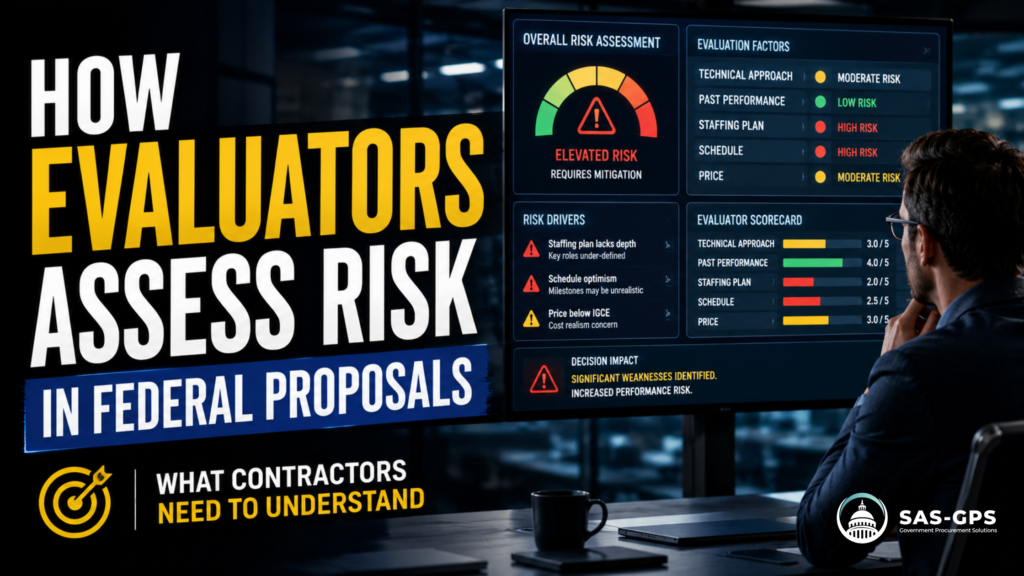
| Quick Answer: How Do Federal Evaluators Assess Proposal Risk? Federal source selection teams assess proposal risk by reviewing the technical approach, past performance, staffing plans, schedules, and price against the requirements in the solicitation. Under FAR Part 15, evaluators formally document weaknesses, significant weaknesses, and deficiencies in the contract file. Each signals a different level of risk that the contractor may be unable to perform successfully. |
Federal agencies evaluate proposals through a lens of risk. Understanding how federal proposal evaluation criteria are applied, and what specifically triggers a weakness, a significant weakness, or a deficiency, is one of the most practical things a capture manager can know.
Most contractors approach proposal writing as a content problem: fill every section, hit every requirement, submit on time. Experienced evaluators see something different. They are reading for risk signals. The way your proposal is structured, substantiated, and priced tells source selection teams whether your company can actually perform what it promised.
At SAS-GPS, we work with contractors across industries on exactly this challenge. The evaluation framework evaluators apply is grounded in the same principles that underpin every winning federal proposal: specificity, substantiation, and alignment to what the agency actually values.
How Federal Source Selection Teams Are Structured
Most competitive acquisitions under FAR Part 15 are evaluated by a Source Selection Evaluation Board (SSEB). The SSEB is made up of subject matter experts assigned to specific evaluation factors: typically technical approach, past performance, management approach, and price.
Each evaluator documents findings independently before the board meets to consolidate ratings. Their written assessments go into the source selection evaluation record, which becomes part of the official contract file. Contractors who request a debriefing after an award can access high-level feedback from that record, and it is one of the most underused intelligence tools in GovCon.
The Source Selection Authority (SSA) makes the final award decision based on the SSEB’s findings. On large or complex acquisitions, a Source Selection Advisory Council (SSAC) reviews SSEB documentation before the SSA signs off.
The FAR Framework for Evaluating Proposal Risk
FAR Part 15 governs negotiated acquisitions and defines how agencies conduct source selections. Under FAR 15.305, contracting officers are required to evaluate proposals based only on the factors and subfactors stated in the solicitation.
Risk is assessed across two primary dimensions:
- Performance risk: the probability that the contractor will successfully fulfill the contract requirements
- Schedule risk: the probability that the contractor will meet required delivery dates and milestones
On cost-reimbursable contracts, FAR 15.305(a)(1) also requires a cost realism analysis: an assessment of whether the contractor’s proposed costs reflect a realistic understanding of the work. An unrealistically low-cost proposal on a cost-reimbursable vehicle is not a competitive advantage; it signals that the contractor may not fully understand the requirement.
What Triggers a Weakness or Significant Weakness
FAR Part 15 defines three specific terms that determine how risk is formally recorded in the evaluation record:
- Weakness: a flaw in the proposal that increases the risk of unsuccessful contract performance
- Significant Weakness: a flaw that appreciably increases the risk of unsuccessful contract performance
- Deficiency: a material failure to meet a solicitation requirement, or a combination of significant weaknesses that increases the risk of unsuccessful performance to an unacceptable level
Deficiencies can disqualify a proposal from the competitive range. Significant weaknesses directly depress adjectival ratings. Understanding what generates each of these is the foundation of proposal risk management.
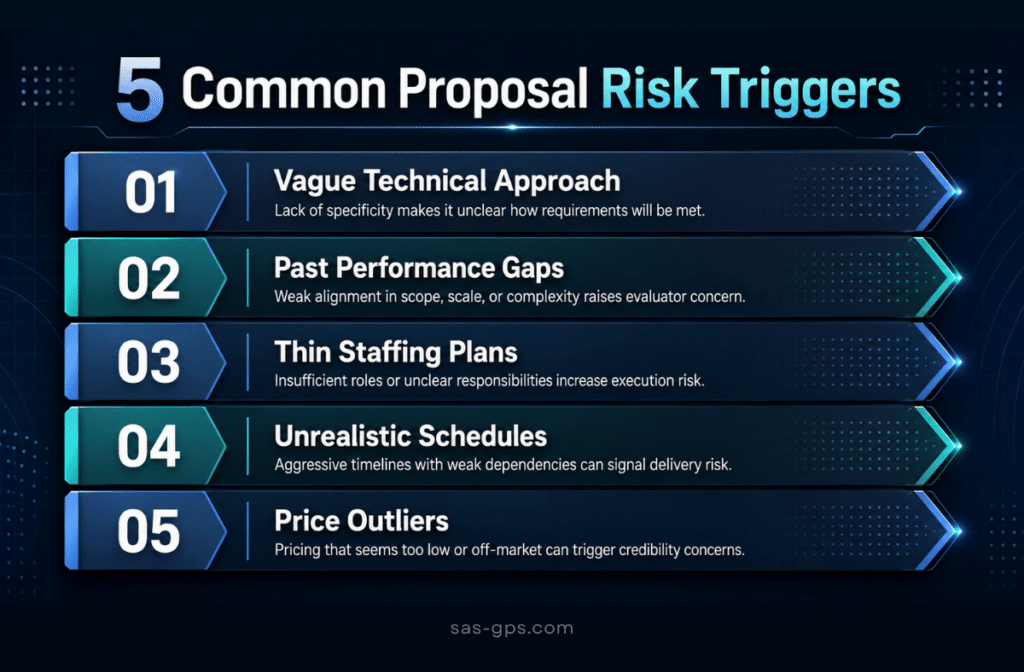
The five most common risk triggers:
Vague Technical Approach
Statements like ‘our experienced team will apply industry best practices’ tell evaluators nothing. Every section of your technical approach should answer how, not just what. Evaluators test specificity: they want to see that you understand the requirement at the task level.
Past Performance Gaps
If your cited contracts do not align with the scope, scale, or complexity of the requirement, evaluators will note the gap. The closer the match, the lower the perceived performance risk. This is why past performance alignment in federal proposals is a strategic exercise, not a documentation task.
Thin Staffing Plans
A staffing section that names key personnel without resumes, or describes a staffing approach without connecting it to a workload analysis, raises execution risk. Evaluators want to see that your staffing plan is grounded in the actual requirements.
Unrealistic Schedules
A schedule that compresses phases without acknowledging dependencies, or lacks measurable milestones tied to deliverables, signals that your team may not have fully thought through execution. Technical evaluators with program experience will test your schedule against the Statement of Work.
Price Outliers
A price significantly below the Independent Government Cost Estimate (IGCE) triggers cost realism concerns on non-fixed-price work and credibility concerns on fixed-price work. Your price-to-win viability analysis should anchor your pricing strategy before you write a number on the page.
How Adjectival Ratings Work and What They Mean for Your Score
Per FAR 15.305, agencies may use color or adjectival ratings, numerical weights, or ordinal rankings to document evaluation findings. Many civilian agencies use a five-point adjectival scale, though the specific terms vary by agency source selection plan:
- Outstanding: proposal contains multiple strengths, no weaknesses
- Good: proposal contains at least one strength, no significant weaknesses
- Acceptable: proposal meets requirements, no significant weaknesses
- Marginal: proposal fails to meet requirements in some areas; significant weaknesses present
- Unacceptable: proposal fails to meet requirements; deficiencies present
A single significant weakness can move a rating from Outstanding to Good or from Good to Acceptable. Multiple significant weaknesses push a proposal toward Marginal. These distinctions directly affect your competitive position in a best-value tradeoff.
Five Ways to Reduce Perceived Risk Before You Submit
Risk reduction is a structural exercise. It starts with how you read the solicitation, not how you write the response.
- Read Section M before Section L. Section M defines evaluation criteria and their relative importance. Section L tells you how to organize your response. Start with what the evaluator is scoring, then structure your technical approach to address each criterion directly.
- Substantiate every claim. For each assertion in your technical approach, ask: where is the evidence? Resumes, past contract performance data, a methodology diagram, a staffing model tied to the PWS. Unsupported claims are weakness candidates.
- Match past performance to the requirement. Select references that mirror the current requirement in scope, scale, and complexity. Quantify deliverables and outcomes. A CPARS rating without context is less compelling than a narrative that makes the match obvious.
- Build a traceable schedule. Show dependencies. Align milestones to deliverables in the Statement of Work. If your schedule can be stress-tested by an evaluator with program experience, it should hold up.
- Price to demonstrate understanding. Work your cost buildup from the bottom up, not from a target number down. A price that reflects a thorough read of the requirements signals competence.
These are the moves that separate compliant proposals from competitive ones. Working with experienced federal proposal writing and development services means having a team that applies this framework on every submission.
Key Takeaways
- Federal evaluators assess risk formally under FAR Part 15, assigning adjectival ratings based on documented weaknesses, significant weaknesses, and deficiencies.
- The five most common risk triggers are vague technical approach, past performance gaps, thin staffing plans, unrealistic schedules, and price outliers.
- Weaknesses and significant weaknesses are FAR-defined terms that directly affect your adjectival rating and competitive position in a best-value tradeoff.
- Risk reduction starts with how you read the solicitation: Section M defines what evaluators are scoring.
- Contractors who request debriefings after an award gain direct access to evaluator findings, one of the most underused intelligence tools in GovCon.
Work With a Federal Proposal Team That Wins
Whether you have an RFP in hand today or you are building your federal strategy for the year ahead, SAS-GPS is ready to help. We provide end-to-end proposal development, compliance review, and pricing support for federal contractors across all industries.
Learn more about our government proposal writing services or contact our team to discuss an active opportunity.