
| Quick Answer: What Is the Biggest Mistake Contractors Make Before Writing a Proposal? The biggest mistake experienced government contractors make is failing to connect capture planning with professional proposal development. Capture establishes the strategic foundation, but proposal development turns that intelligence into a clear, compliant, and persuasive submission. Strong positioning cannot replace strong proposal execution, just as polished writing cannot fully compensate for a lack of strategy. Contractors need both to compete effectively. |
Winning competitive federal contracts requires two things done well: strategic positioning before the solicitation drops, and a technically excellent, fully compliant proposal when it does. Contractors who treat these as separate concerns, or who compress the capture phase to focus on writing, consistently leave a competitive advantage on the table. This article explains how pre-proposal preparation and professional proposal development work together to produce a stronger, more competitive submission.
Why Capture Planning and Proposal Writing Work Together?
Contractors who invest in capture planning but submit a poorly structured or non-compliant proposal lose opportunities they spent months positioning for. Contractors who write strong proposals without capture groundwork submit competitive documents for opportunities they were never strategically positioned to win.
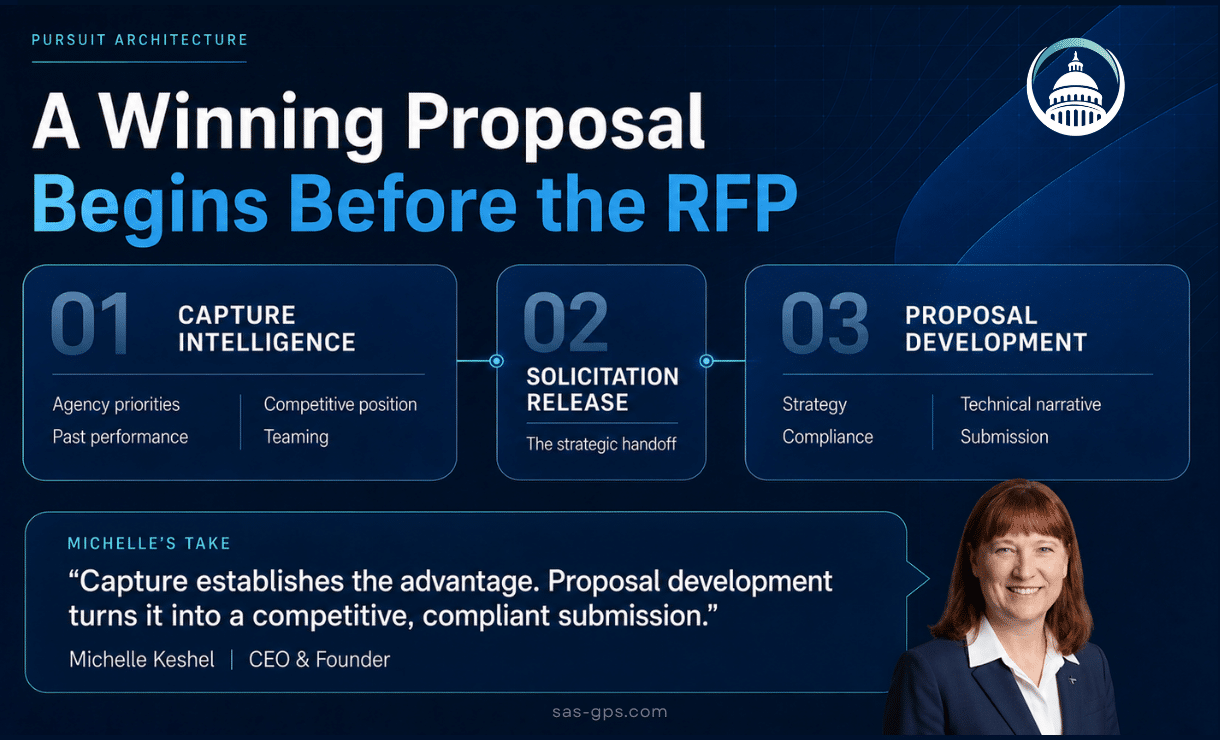
The firms consistently winning significant federal contracts treat capture planning and professional proposal development as two sides of the same pursuit strategy. The capture phase builds the competitive intelligence and strategic foundation. The proposal phase is where that foundation is translated into a document that scores. Both phases require disciplined execution, and shortcutting either one damages the overall result.
Agencies awarding major contracts have typically spent months developing requirements, engaging industry, and forming impressions of the vendor landscape before a formal solicitation is released. Contractors who have been part of that pre-solicitation engagement arrive at the RFP stage with a clear picture of the agency’s priorities, how the agency is likely to weigh the evaluation criteria, and what the competitive field looks like. That intelligence directly improves proposal quality and scoring at every stage of development.
Source: FAR Part 15, Contracting by Negotiation https://www.acquisition.gov/far/part-15
What Strong Capture Activity Looks Like in Practice
Capture planning for competitive federal opportunities is not a checklist exercise. It is a structured intelligence-building process that runs parallel to business development activity and informs every proposal decision that follows.
Effective capture includes:
- Researching the agency’s budget priorities, prior awards, and procurement history through USAspending.gov and agency forecast tools
- Submitting substantive, capability-aligned responses to Sources Sought and RFI notices that demonstrate relevant expertise
- Mapping anticipated evaluation criteria against documented past performance, identifying gaps, and addressing them before the solicitation drops
- Confirming teaming arrangements with partners who fill real capability or socioeconomic gaps, not partners assembled under deadline pressure
- Building competitive intelligence on likely offerors and understanding their positioning relative to your own
Contractors who complete this work before RFP release enter proposal development with a strategic blueprint already in place. The proposal writing team is executing a plan, not inventing one under deadline pressure. That distinction is reflected in the quality and competitiveness of the final submission.
Source: SAM.gov Contract Opportunities https://sam.gov
Source: USAspending.gov https://www.usaspending.gov
The Past Performance Gap That Quietly Undermines Strong Proposals
Past performance evaluation in competitive federal procurements is rigorous. Evaluators assess relevance, recency, and performance quality against the specific scope and scale of the requirement. Contracts that look strong internally often score below expectations because the scope does not match closely enough, the contract values do not align with the required annualized value, or the recency falls outside the evaluation window.
The contractors who consistently score well on past performance have assessed their portfolio against the anticipated requirement before the solicitation drops. They know which contracts to cite, which ones to leave out, and where teaming partners need to carry the weight.
When past performance gaps are identified in the pre-RFP phase, contractors have more time to address them through strategic teaming or other qualifying experience. When those gaps are discovered after the RFP is released, they become more difficult to manage, but professional proposal support remains valuable. An experienced proposal team can identify the strongest available references, incorporate relevant teaming-partner experience where permitted, and develop narratives that clearly connect the team’s qualifications to the solicitation’s requirements.
Source: FAR 15.305, Proposal Evaluation https://www.acquisition.gov/far/15.305
Why Professional Proposal Support Matters Most at This Stage
The capture-to-proposal handoff is where experienced contractors most benefit from external proposal support. Internal teams who have been close to the capture work for months bring institutional knowledge but also blind spots. They know what they meant to say. External proposal professionals read what is actually on the page and evaluate it the way a source selection official will.
The proposal is the document the agency ultimately evaluates. Its competitiveness depends on the precision of the technical narrative, the strength and relevance of the past performance write-ups, the clarity of the proposed solution, and compliance across every volume. Capture planning establishes the direction, while professional proposal development ensures that the contractor’s strategy and qualifications are communicated clearly and persuasively.
These are not areas where contractors who are serious about winning cut corners. They are areas where the investment in professional proposal development pays off most clearly and most measurably in win rates over time.
The Pre-Proposal Mistakes That Cost Contractors Bids
- Beginning capture activity at RFP release rather than months earlier, entering proposal development without the strategic foundation that competitive submissions require
- Skipping RFI and Sources Sought responses, losing early visibility into agency priorities and evaluation thinking that would have strengthened the proposal strategy
- Discovering past performance gaps after solicitation release, leaving no time to address them through teaming or supplemental experience before the proposal is due
- Forming teaming arrangements under deadline pressure, producing partnerships that lack the structure and credibility evaluators look for
- Relying solely on internal teams for proposal development and review, missing the compliance gaps and scoring weaknesses that external proposal professionals consistently identify
Key Takeaways
- Capture planning and professional proposal development are not competing priorities. They are sequential phases of the same pursuit strategy, and shortcutting either one damages the result.
- Responding substantively to Sources Sought notices and RFIs is a competitive activity that builds agency familiarity and directly improves the strategic foundation your proposal is built on.
- Past performance gaps identified before the solicitation is released provide contractors with more time to consider teaming or other strategic solutions. After release, professional proposal support can help contractors select the strongest available references and present their experience in the clearest and most relevant way permitted by the solicitation.
- Teaming arrangements structured before the RFP are more credible and more strategically sound than partnerships assembled under deadline pressure after the solicitation is released.
- The investment in professional proposal development consistently pays off in submission quality, compliance rigor, and win rates over time.
Work With a Federal Proposal Team That Wins
SAS-GPS works with experienced federal contractors pursuing competitive opportunities across all industries and contract vehicles. We provide capture strategy support, end-to-end proposal development, compliance review, and submission management for contractors who are serious about winning.
Contact our team to discuss your next opportunity. sas-gps.com/contact-us
Sources
- FAR Part 15, Contracting by Negotiation: https://www.acquisition.gov/far/part-15
- FAR 15.305, Proposal Evaluation: https://www.acquisition.gov/far/15.305
- SAM.gov Federal Contract Opportunities: https://sam.gov
- USAspending.gov Federal Spending Data: https://www.usaspending.gov