| Quick Answer: Why Does Winning Start Before the RFP Is Released? Winning federal contracts often begins before the RFP is released. Experienced contractors use the pre-solicitation period to validate customer priorities, assess competitors, refine their solution, align teaming and pricing strategies, and identify performance risks. When the solicitation is released, professional proposal development turns that groundwork into a compliant, persuasive, and evaluator-focused response. Even when pre-solicitation planning has been limited, an experienced proposal team can help identify gaps, strengthen the pursuit strategy, organize the response, and improve the company’s competitive position within the available schedule. |
Government Procurement is a Continuous Competitive Process
The release of an RFP is a formal milestone in a competitive process that may have been developing for months or years.
Before a solicitation appears on SAM.gov, the agency may have conducted acquisition planning, market research, industry engagement, requirements development, budget validation, acquisition strategy reviews, and internal risk assessments.
During that same period, well-positioned contractors may already have:
- Monitored agency forecasts and acquisition pipelines
- Assessed the customer’s mission, operating environment, and procurement history
- Evaluated the incumbent’s position and likely recompete strategy
- Responded selectively to Requests for Information and Sources Sought notices
- Identified potential prime, subcontractor, and small-business relationships
- Tested solution assumptions against customer priorities
- Reviewed staffing availability and labor market constraints
- Assessed contract vehicle, security, transition, and performance requirements
- Developed an initial pricing and competitive strategy
- Identified gaps in past performance, capabilities, certifications, or personnel
These activities are not separate from proposal development. They establish a stronger foundation for the proposal team and allow more time to focus on strategy, differentiation, evidence, and evaluator confidence.
When an organization delays these decisions until the solicitation is released, the proposal team must resolve strategic, technical, contractual, staffing, and pricing issues while managing a compressed production schedule.
That creates avoidable risk, but it does not mean the pursuit cannot be strengthened. Professional proposal support can help the team prioritize unresolved decisions, identify weaknesses, organize contributors, and develop the strongest possible response within the time available.
Six Critical Insights
- Capture Planning and Proposal Development Are One Pursuit Continuum
- Three Strategic Mistakes That Reduce Proposal Competitiveness
- Proposal Development Is a Business Development Function
- Critical Questions Should Be Resolved Before Drafting Begins
- Compliance Is Necessary, but It Does Not Establish Competitive Advantage
- Professional Proposal Development Strengthens the Pursuit at Every Stage
Critical Insight 1: Capture Planning and Proposal Development Are One Pursuit Continuum
Capture and proposal development are frequently managed as separate functions, with different owners, schedules, deliverables, and performance measures.
Operational separation may be necessary. Strategic separation is not.
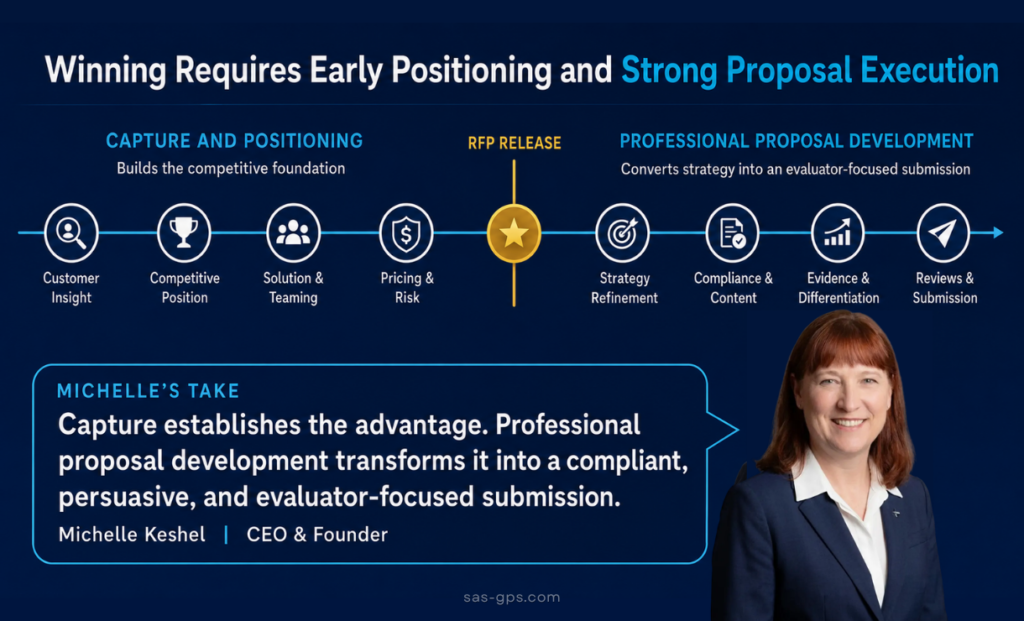
Capture establishes the basis of the pursuit:
- Customer and stakeholder priorities
- Acquisition drivers
- Competitive positioning
- Solution strategy
- Teaming approach
- Pricing posture
- Key personnel strategy
- Relevant past performance
- Discriminators
- Risks and mitigation strategies
- Bid and no-bid rationale
Proposal development converts those decisions into an evaluator-focused submission.
The quality of that conversion depends partly on the quality of the information transferred from capture. Weak handoffs frequently result in generic messaging, unsupported win themes, inconsistent solution descriptions, poorly selected past performance, and proposal sections that comply individually but do not reinforce a unified strategy.
A mature transition from capture to proposal should provide the proposal team with more than background information. It should establish:
- What the customer values
- What the evaluation methodology rewards
- Where the organization is advantaged or vulnerable
- Which claims can be substantiated
- Which risks require active mitigation
- Which competitors are most relevant
- Why the proposed solution is credible
- How each proposal volume supports the overall case for award
The strongest proposals are not assembled from independent sections. They are built around a coherent evaluation strategy.
Customer priorities influence the technical approach. Competitive intelligence shapes messaging. Pricing strategy supports the value proposition. Past performance validates execution credibility. Management and transition plans reduce perceived performance risk. Graphics reinforce complex relationships, processes, and benefits.
Professional proposal management ensures that these elements remain aligned from kickoff through final production.
When capture information is incomplete, the proposal team can also facilitate focused strategy sessions, challenge unsupported assumptions, identify information gaps, and help contributors develop a more integrated response.
Source: FAR Part 15, Contracting by Negotiation
Critical Insight 2: Three Strategic Mistakes That Reduce Proposal Competitiveness
Experienced contractors do not typically lose because they are unfamiliar with proposal requirements. They often lose because strategic decisions are made too late, implemented inconsistently, or communicated without sufficient evidence.
Mistake 1: Deferring Pursuit Strategy Until Solicitation Release
By the time the RFP is released, the organization should ideally have developed an informed position on:
- Customer priorities
- Anticipated evaluation factors
- Competitive threats
- Incumbent strengths and vulnerabilities
- Solution architecture
- Staffing and key personnel
- Transition risk
- Teaming requirements
- Relevant past performance
- Pricing posture
- Major discriminators
- Bid and execution risk
The solicitation will refine and sometimes change those assumptions. It should not trigger the first serious discussion about them.
A proposal team that begins with unresolved strategic questions spends valuable schedule time creating the pursuit strategy while simultaneously trying to document it.
That often produces predictable consequences:
- Delayed section assignments
- Conflicting solution descriptions
- Repeated rewrites
- Unsupported claims
- Weak executive summaries
- Late pricing changes
- Unresolved compliance issues
- Graphics that illustrate content without strengthening the argument
- Color reviews focused on basic completeness rather than competitiveness
A mature proposal kickoff should confirm and operationalize the strategy, not develop it from scratch.
However, when strategy development begins later than intended, experienced proposal professionals can help accelerate decision-making, facilitate solution development, establish content priorities, and keep the team focused on the evaluation.
Mistake 2: Treating Pre-Solicitation Engagement as Administrative Activity
Sources Sought notices, Requests for Information, draft solicitations, industry days, one-on-one meetings, and acquisition forecasts provide more than procedural visibility.
Used appropriately, they can help contractors:
- Test their interpretation of the requirement
- Evaluate whether the acquisition strategy favors or constrains their position
- Identify restrictive or ambiguous requirements
- Assess the likely competitive pool
- Evaluate small-business and teaming implications
- Determine whether the opportunity warrants continued investment
- Refine solution, staffing, contract vehicle, and pricing assumptions
- Develop a more realistic understanding of customer risk
Not every notice warrants a response. Not every opportunity warrants sustained capture investment.
The objective is not participation for its own sake. The objective is better decision-making and stronger positioning.
Organizations that treat pre-solicitation activity as a compliance exercise miss an important opportunity to improve qualification discipline and reduce pursuit risk before proposal costs escalate.
Mistake 3: Equating Compliance With Competitiveness
Compliance protects eligibility, but it does not create a competitive advantage.
Federal evaluators may receive multiple proposals that satisfy the instructions, address the evaluation criteria, comply with page limits, and present technically acceptable approaches.
The award decision depends on how effectively each proposal establishes confidence, value, relevance, and performance credibility within the stated evaluation framework.
Competitive proposals do more than answer requirements.
They:
- Connect solution elements to customer outcomes
- Quantify benefits where supportable
- Demonstrate relevant and recent execution experience
- Address risk directly
- Present credible staffing and transition approaches
- Make discriminators easy to identify and evaluate
- Maintain consistency across technical, management, past performance, and price volumes
- Support major claims with evidence
- Reduce evaluator effort
- Align messaging with the basis of award
Compliance earns entry into the competition.
Strategic communication improves the probability of selection.
Critical Insight 3: Proposal Development Is a Business Development Function
Proposal development is often described as writing and production under deadline.
That description is incomplete.
Proposal development is the phase in which the organization must convert its capabilities, customer knowledge, competitive position, solution, and execution evidence into an evaluated case for award.
The proposal must satisfy two standards simultaneously:
- It must respond fully and precisely to the solicitation.
- It must establish why the proposed approach represents a superior or lower-risk choice under the evaluation criteria.
Those standards are related, but they are not interchangeable.
A compliant proposal can still fail to:
- Distinguish the offeror
- Demonstrate meaningful value
- Establish execution credibility
- Address customer risk
- Present an integrated solution
- Support claims with evidence
- Make strengths easy for evaluators to document
- Align with the stated basis of award
Strong proposal teams manage content around evaluator decisions, not internal organizational structures.
They select past performance because it supports the proposed work, not simply because it represents the company’s largest contract.
They use graphics to clarify relationships, sequencing, accountability, risk controls, and outcomes.
They develop executive summaries around the customer’s decision, not around a generic corporate introduction.
They align technical, management, transition, staffing, and pricing narratives so the proposal presents one credible solution rather than several loosely connected responses.
The proposal is not simply a record of what the organization intends to provide. It is the evaluated representation of the organization’s readiness to perform.
Source: FAR 15.305, Proposal Evaluation
Critical Insight 4: Critical Questions Should Be Resolved Before Drafting Begins
Experienced pursuit teams should enter proposal development with informed answers to the questions most likely to affect the evaluation.
Those questions include:
- Why is the customer pursuing this acquisition now?
- Which mission, operational, cost, schedule, or performance risks are driving the requirement?
- Which evaluation factors are likely to determine the award?
- Where does the incumbent hold a competitive advantage?
- Where is the incumbent vulnerable?
- Which competitors are most credible?
- What does the organization offer that is both relevant and defensible?
- Which aspects of the solution reduce customer risk?
- Which past performance examples best validate the proposed approach?
- Which teaming partners improve the evaluation position?
- Which partners add capacity without adding meaningful competitive value?
- Are the proposed key personnel available, qualified, and committed?
- Is the staffing model executable in the relevant labor market?
- What transition assumptions require validation?
- Which solution elements affect price competitiveness?
- Which claims can be supported with metrics, outcomes, or customer evidence?
- Where is the organization exposed technically, contractually, operationally, or financially?
- What conditions would justify a no-bid decision?
These questions should influence the pursuit before substantial proposal resources are committed.
They should also remain active throughout proposal development. The solicitation may alter assumptions, change evaluation priorities, introduce new risks, or require a different solution posture.
The objective is not to freeze the strategy before release. It is to enter the proposal phase with a mature position that can be tested and refined against the final RFP.
When complete answers are not yet available, the proposal team can help structure the discussions, identify the highest-priority decisions, document assumptions, and ensure that unresolved issues are addressed before they weaken the final response.
Source: FAR Part 7, Acquisition Planning
Critical Insight 5: Compliance Is Necessary, but It Does Not Establish Competitive Advantage
Proposal compliance remains fundamental.
Failure to follow solicitation instructions, address evaluation criteria, comply with formatting requirements, observe page limits, follow submission procedures, or adhere to applicable provisions of the Federal Acquisition Regulation can weaken a proposal or remove it from consideration.
However, mature proposal organizations do not treat compliance as a final-stage quality check.
They integrate compliance into:
- The proposal outline
- Section planning
- Writing assignments
- Compliance matrices
- Content plans
- Graphics planning
- Review criteria
- Cross-volume validation
- Final production
- Submission controls
Compliance should be traceable, visible, and difficult to lose during revisions.
At the same time, strict compliance does not guarantee a competitive response.
Evaluators still need a clear basis for assigning strengths, assessing risk, validating relevance, and distinguishing among qualified offerors.
That requires:
- Specificity
- Evidence
- Consistent messaging
- Relevant past performance
- Credible methods
- Clear accountability
- Realistic staffing
- Effective risk controls
- Measurable benefits
- Evaluator-focused organization
The strongest proposals make it easy for evaluators to identify where and how the offeror exceeds requirements, reduces performance risk, or delivers superior value.
Critical Insight 6: Professional Proposal Development Strengthens the Pursuit at Every Stage
Professional proposal development delivers the greatest value when it is integrated with capture, solution, pricing, operational, and executive decision-making.
Early involvement gives the proposal team more time to understand the opportunity, challenge assumptions, organize evidence, develop messaging, and align the pursuit around the evaluation.
However, experienced proposal professionals can also add substantial value after the solicitation has been released.
They can:
- Identify strategic and compliance gaps
- Facilitate solution development
- Challenge weak or unsupported assumptions
- Clarify customer benefits and discriminators
- Strengthen win themes
- Improve the selection and presentation of past performance
- Organize technical and management content
- Align contributors and subject matter experts
- Develop executive summaries
- Improve proposal graphics
- Coordinate reviews
- Manage production and submission
- Help the team make informed decisions within a compressed schedule
Proposal professionals cannot create past performance that does not exist or guarantee access to unavailable personnel. They can, however, help the organization make the best use of the capabilities, evidence, resources, and competitive advantages it already has.
They can also help identify when additional teaming, staffing, solution development, research, or executive decisions are needed.
This is why professional proposal support should not be viewed as a final editing service.
It may include:
- Capture strategy
- Opportunity qualification
- Competitive assessment
- Solution development facilitation
- Proposal strategy
- Proposal management
- Compliance management
- Technical and management writing
- Past performance development
- Executive summary development
- Color team reviews
- Proposal graphics
- Pricing coordination
- Final production
Organizations with mature internal capture and proposal functions may use external experts to expand capacity, introduce specialized expertise, challenge internal assumptions, or support a high-volume pursuit environment.
Organizations with limited internal resources may require a more integrated model spanning capture through submission.
Organizations that engage support after the RFP is released may need experienced professionals who can quickly assess the opportunity, establish a workable proposal process, prioritize critical decisions, and develop a strong response within the remaining schedule.
In every case, the objective is the same: preserve strategic continuity across the pursuit and produce a proposal that is compliant, credible, differentiated, and aligned with the evaluation.
The best proposals are not simply well written.
They reflect a pursuit that has been carefully assessed, strategically positioned, operationally supported, and consistently managed.
Professional proposal development helps bring those elements together, whether support begins during capture or after the solicitation is released.
That is why winning often starts before the RFP is released, and why experienced proposal support remains critical throughout the pursuit.
Work With a Federal Proposal Team That Wins
For more than two decades, SAS-GPS has helped government contractors compete across the federal procurement lifecycle.
SAS-GPS works as an extension of our clients’ pursuit teams, providing scalable expertise from early capture planning through final submission.
We support established government contractors that need additional capacity, specialized proposal expertise, independent review, or end-to-end support for a priority pursuit.
Whether a client needs to strengthen an existing internal team, address gaps after a solicitation is released, or manage a comprehensive proposal effort, SAS-GPS helps translate pursuit strategy into compliant, compelling, and evaluator-focused proposals.
If your organization is preparing for an upcoming federal opportunity or responding to an active solicitation, contact SAS-GPS to discuss the pursuit.
Contact our team to discuss your next opportunity.
Sources
- FAR Part 15, Contracting by Negotiation: https://www.acquisition.gov/far/part-15
- FAR Part 7, Acquisition Planning: https://www.acquisition.gov/far/part-7
- FAR 15.305, Proposal Evaluation: https://www.acquisition.gov/far/15.305
- SAM.gov Contract Opportunities: https://sam.gov
- SAM.gov Sources Sought and Opportunities: https://sam.gov/content/opportunities
- SBA Federal Contracting Guide: https://www.sba.gov/federal-contracting