Should You Pursue Every Government Contract Opportunity?

Quick Answer: Should You Pursue Every Government Contract Opportunity? One of the most expensive mistakes in federal contracting is assuming that every opportunity matching your capabilities deserves a proposal. It does not. Capability alignment confirms that your organization can perform the work. It does not determine whether the opportunity warrants the investment required for capture […]
Why Winning Starts Before the RFP Is Released
Quick Answer: Why Does Winning Start Before the RFP Is Released? Winning federal contracts often begins before the RFP is released. Experienced contractors use the pre-solicitation period to validate customer priorities, assess competitors, refine their solution, align teaming and pricing strategies, and identify performance risks. When the solicitation is released, professional proposal development turns that […]
The Biggest Mistake Government Contractors Make Before Writing a Proposal

Quick Answer: What Is the Biggest Mistake Contractors Make Before Writing a Proposal? The biggest mistake experienced government contractors make is failing to connect capture planning with professional proposal development. Capture establishes the strategic foundation, but proposal development turns that intelligence into a clear, compliant, and persuasive submission. Strong positioning cannot replace strong proposal execution, […]
From SAM.gov to Submission: A Contractor’s Timeline for the Federal RFP Process
Quick Answer: What Is the Federal RFP Process? The federal RFP (Request for Proposal) process is the sequence of phases a government contractor moves through from initial opportunity identification to final proposal submission. It includes five stages: opportunity identification, pre-RFP capture activity, RFP release and compliance review, proposal development and internal review, and submission. Contractors […]
Red Team Reviews in Federal Proposals: How to Support Your Proposal Writers
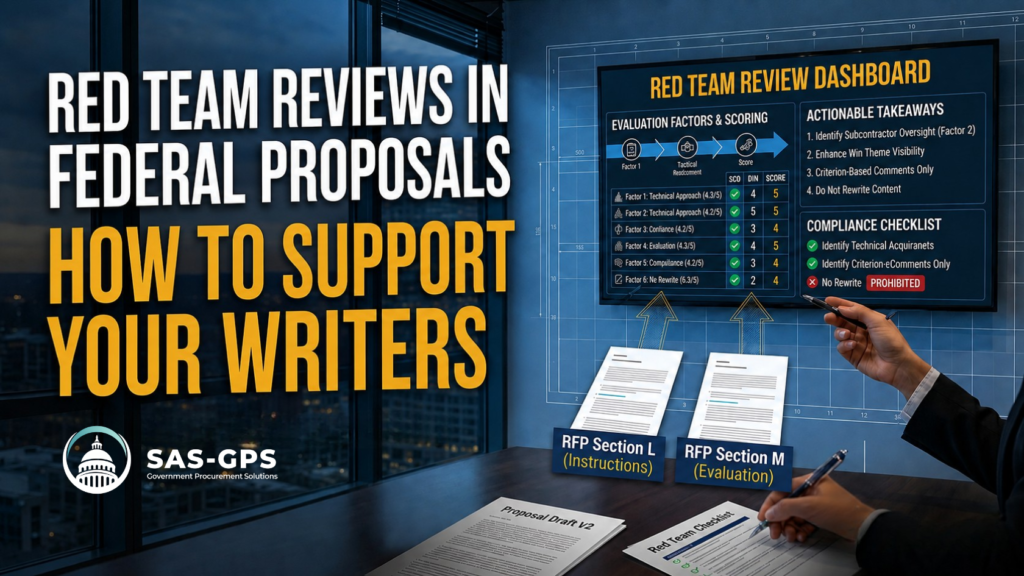
Quick Answer: What Is a Red Team Review? A federal proposal red team review is a structured evaluation of a proposal draft against the solicitation’s evaluation criteria. Its purpose is to identify compliance gaps, weak narratives, and areas where the proposal fails to communicate the offeror’s strengths clearly to an evaluator. It is not a […]
How to Turn Your Small Business Set-Aside Into a Federal Contract Pipeline

Quick Answer: What Is a Small Business Set-Aside Contract? A small business set-aside contract is a federal procurement opportunity that the government reserves exclusively for small businesses. By restricting competition to eligible firms, set-asides reduce the number of competitors a small business faces and create a direct pathway to federal contract awards without going head-to-head […]
Why Federal Contractors Hire GSA Schedule Consultants

Quick Answer: What Is GSA Schedule Consulting? GSA Schedule consulting is a professional service that helps federal contractors prepare, submit, and manage a Multiple Award Schedule (MAS) contract through the General Services Administration (GSA). Consultants guide contractors through eligibility assessment, offer preparation, price negotiation, and post-award compliance to maximize the value of their Schedule contract. […]
How Evaluators Assess Risk in Federal Proposals: What Contractors Need to Understand
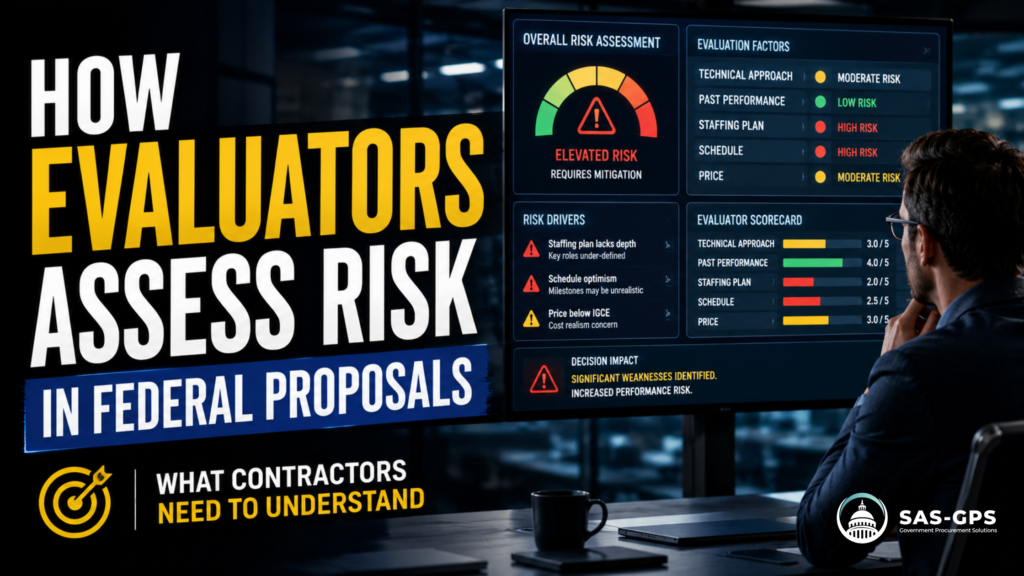
Quick Answer: How Do Federal Evaluators Assess Proposal Risk? Federal source selection teams assess proposal risk by reviewing the technical approach, past performance, staffing plans, schedules, and price against the requirements in the solicitation. Under FAR Part 15, evaluators formally document weaknesses, significant weaknesses, and deficiencies in the contract file. Each signals a different level […]
Opportunity Qualification in Government Contracting: How to Decide Which Bids Are Worth Pursuing

Quick Answer: What Is Opportunity Qualification in Government Contracting? Opportunity qualification, in government contracting is the process of evaluating whether a specific federal bid is worth pursuing before committing proposal development resources. It assesses a contractor’s competitive position, past performance alignment, pricing viability, and agency relationships to determine whether pursuing the opportunity is likely to […]
What’s Changing in Federal Contracting in 2026

The Federal Contracting Shift Happening Right Now: Why Many Firms Are Already Behind A company spends four weeks on a proposal. The solution is solid. The pricing is competitive. Past performance looks relevant. They still lose. Not because a competitor wrote a better narrative. Because their past performance did not score the way they thought […]