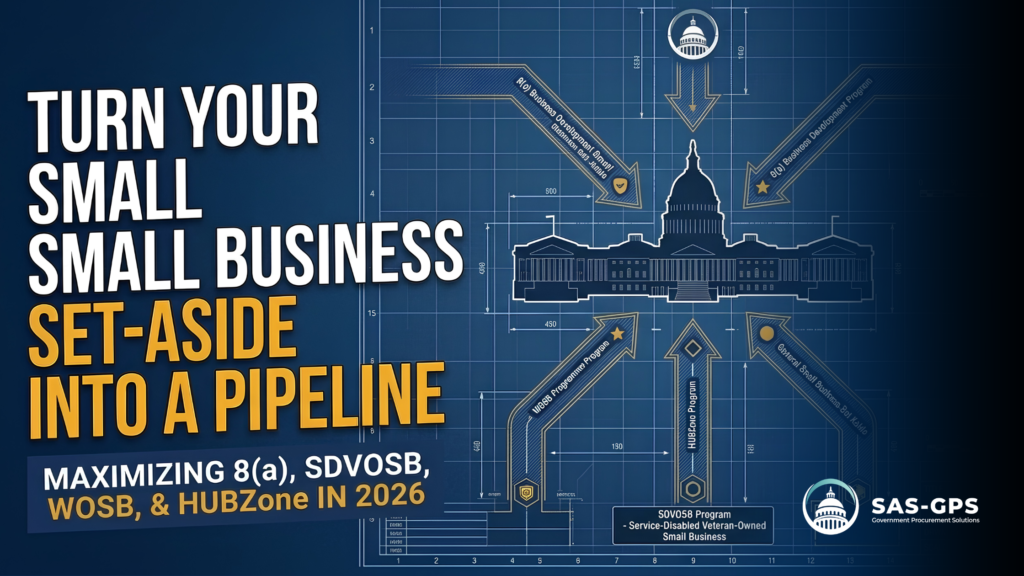
| Quick Answer: What Is a Small Business Set-Aside Contract? |
| A small business set-aside contract is a federal procurement opportunity that the government reserves exclusively for small businesses. By restricting competition to eligible firms, set-asides reduce the number of competitors a small business faces and create a direct pathway to federal contract awards without going head-to-head against large prime contractors. |
Getting a small business set-aside certification is the first step. Using it to actually win contracts is a different discipline entirely. Many contractors complete the certification process, register on SAM.gov (the System for Award Management, required for all federal contract participation), and then wait for opportunities to materialize. They rarely do on their own.
A set-aside designation gives you access to a restricted competition pool. That access has real value. But it only converts into revenue when paired with a deliberate targeting strategy, active opportunity pursuit, and proposal execution that is built for how federal evaluators actually score submissions.
This article covers how to translate a set-aside certification into a functioning federal pipeline, what the current landscape means for each program, and the three actions that move certified contractors from registered to winning.
| Current Landscape: What Is Changing in 2026 |
| The set-aside environment is shifting in ways that directly affect how contractors should use their certifications. |
| 8(a) Program under audit: In December 2025, the SBA ordered all 4,300 active 8(a) firms to produce three years of financial records. By March 2026, SBA had suspended over 1,000 firms and initiated termination proceedings against more than 620 others. The SBA also reduced the Small Disadvantaged Business (SDB) contracting goal to its statutory 5%. Source: SBA Press Release, March 4, 2026 |
| WOSB program stable: The Women-Owned Small Business (WOSB) program’s 5% federal contracting goal remains in place and unchanged from its statutory target. WOSB certifications remain valid and active. |
| SDVOSB program growing: Bipartisan legislation in 2025 actively strengthened the Service-Disabled Veteran-Owned Small Business (SDVOSB) program, increasing agency accountability for hitting veteran contracting goals. |
| The bottom line: if you hold a set-aside certification, the window to use it strategically has never been more important to act on. A certification sitting idle is a wasted asset, and the landscape will keep shifting. |
What Makes Set-Asides Useful for Pipeline Building?
Under FAR 19.502-2 (Federal Acquisition Regulation, the rulebook governing federal procurement), contracting officers are required to set aside acquisitions above $250,000 for small businesses when there is a reasonable expectation that at least two small businesses can compete. This means a significant portion of federal spending is already structured to favor small business competition before you submit a single proposal.
The practical effect: when you compete for a set-aside contract, you are not going up against large primes with full proposal teams, established agency relationships, and decades of past performance. You are competing against other small businesses. That is a fundamentally different competitive environment.
Sole-source awards are also available under most programs. Under current FAR thresholds, contracting officers can award directly to a single 8(a) firm up to $4.5 million (or $7.5 million for manufacturing), and to a single SDVOSB, WOSB, or HUBZone firm up to $4.5 million (or $7 million for manufacturing), without running a full competition. For a contractor focused on capture planning in government contracting, sole-source awards are one of the highest-value pipeline opportunities available.
Three Ways to Activate Your Set-Aside Certification
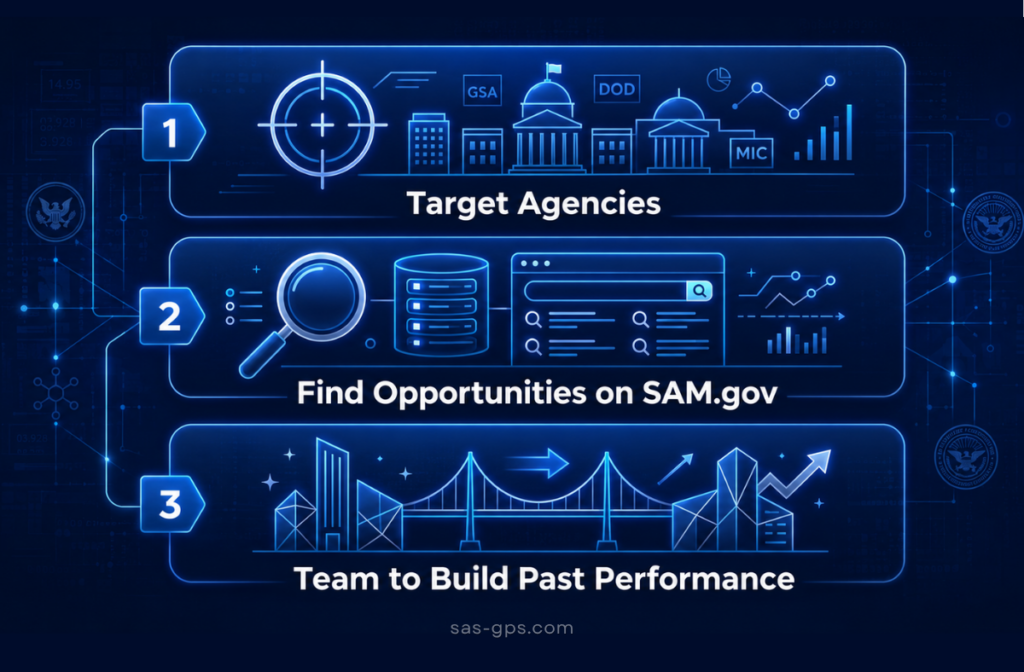
Most contractors use their set-aside passively. They list the designation in SAM.gov, respond to broad solicitations when they appear, and hope agencies find them. A pipeline-oriented approach looks different.
1. Target agencies that already buy what you sell
Start with USASpending.gov to identify which federal agencies have awarded contracts in your NAICS code (North American Industry Classification System, the code that defines your primary service category) in the past two to three fiscal years. Filter by set-aside type. You will quickly identify which contracting offices are active buyers in your space and which ones use set-asides regularly.
Agencies with a history of set-aside awards in your NAICS code are your highest-priority targets. They have already demonstrated a pattern of buying through the vehicle you hold.
2. Find and pursue specific opportunities on SAM.gov
SAM.gov (sam.gov) is where all federal contract opportunities above $25,000 that are not on contract vehicles are posted. Use the advanced search filters to narrow by set-aside type, NAICS code, agency, and award dollar range. Set up saved searches and email alerts so you are notified when new solicitations match your profile.
Also search for Sources Sought notices and Requests for Information (RFIs). These are pre-solicitation postings where agencies gather market research before issuing a formal RFP. Responding to Sources Sought puts you on the agency’s radar before the competition officially opens and sometimes directly shapes whether the final solicitation is set aside for your program.
3. Use teaming to build past performance
Past performance is the most common barrier for certified firms that have not yet won a federal contract. The fastest way through it is teaming. By subcontracting under an established prime, you accumulate past performance citations in your NAICS code that can be referenced in future proposals. The SBA’s Mentor-Protege Program, available to small businesses certified under multiple programs, formalizes this relationship and provides additional business development support. For a deeper look at how to evaluate which opportunities are worth pursuing, calculating PWIN for a government contract provides a useful framework before you invest in a full proposal effort.
What Certified Contractors Get Wrong
The most common mistake is treating certification as an end state. A set-aside designation does not appear in agency systems as a recommendation. Agencies do not search for certified firms and send them contracts. The contractor has to pursue the opportunity.
The second most common mistake is ignoring NAICS code alignment. Size standards for small business eligibility vary by NAICS code, not by company size in the abstract. A firm that qualifies as a small business under one code may not qualify under another. Contractors should verify their size standard under every NAICS code they intend to pursue and confirm eligibility before submitting a proposal.
The third is letting certifications lapse. Set-aside certifications require recertification on a defined schedule. An 8(a) firm that misses a compliance requirement, a WOSB that fails to report a material change in ownership, or a HUBZone firm whose principal office relocates outside the zone can lose the certification. Once lost, re-entry into some programs is not immediate. Tracking recertification dates is a basic operational requirement.
Frequently Asked Questions
Can a firm hold more than one set-aside designation?
Yes. Many small businesses hold multiple designations simultaneously. A service-disabled veteran-owned woman-owned small business can be certified as both SDVOSB and WOSB, for example. Each certification has its own eligibility requirements and recertification schedule. Holding multiple designations expands the set-aside opportunities a firm is eligible to pursue.
Is the 8(a) program still active in 2026?
Yes. The 8(a) program is active. The SBA’s audit activity in 2025 and 2026 targeted fraud and non-compliance, not the program itself. Firms that are compliant, have current financial documentation, and meet eligibility requirements remain in the program. New applications continue to be accepted. The program’s compliance bar has risen, which means documentation hygiene is now more important than ever for existing participants.
What is the fastest way to get past performance if I have none?
Subcontracting under an established prime contractor is the most direct path. Primes are required by FAR to provide subcontracting opportunities to small businesses on contracts above certain thresholds. Small Business Liaison Officers (SBLOs) at large primes are the right point of contact. Responding to subcontracting outreach on SAM.gov’s dynamic small business search and on prime contractor supplier diversity portals are also effective entry points.
How do I know which set-aside program is right for my business?
Eligibility is determined by ownership structure, veteran or disability status, geography (for HUBZone), and size standards. The SBA provides eligibility guidance for each program at sba.gov. The most important factor in choosing where to focus is where your target agencies are actively awarding. A WOSB certification is most valuable when you are pursuing agencies with active WOSB spend in your NAICS code. Certification value is directly linked to the buying patterns of the agencies you are targeting.
From Certification to Proposal Execution
A set-aside opportunity still requires a competitive proposal. Contracting officers score submissions against stated evaluation criteria. Section L tells you what to submit; Section M tells you how it will be scored. A certified firm that submits a weak technical narrative, misses a compliance requirement, or prices itself out of the competitive range loses the award regardless of its set-aside status.
If you have a set-aside certification and an active opportunity in front of you, the next step is a proposal that is written to win. That means technical volume alignment with the Statement of Work, past performance citations that match the scope, and a price that reflects competitive market rates. Our government proposal writing and development services are designed specifically to support contractors at exactly this stage.
| Key Takeaways |
| A set-aside certification reduces your competition pool but does not automatically generate contract awards. Active pursuit strategy is required. |
| SAM.gov registration is mandatory before pursuing any federal contract. It is the foundational step every contractor must complete first. |
| The 8(a) program is under unprecedented audit pressure in 2026. Firms in the program must have financial documentation current and defensible. |
| SDVOSB is the strongest-positioned set-aside program heading into FY 2026. WOSB maintains its 5% contracting goal unchanged. |
| Teaming with an experienced prime is the fastest path to building past performance when you hold a set-aside designation but have not yet won a federal contract. |
| Set-aside certifications expire and require recertification. Letting a certification lapse means losing access to restricted competition pools. |
Work With a Federal Proposal Team That Wins
Whether you have an RFP in hand today, are pursuing a contract vehicle, or are building your federal strategy for the year ahead, SAS-GPS is ready to help. We provide end-to-end proposal development, compliance review, pricing support, and contract vehicle pursuit strategy for federal contractors across all industries.
Learn more about our government proposal writing services or contact our team to discuss an active opportunity.
Sources
SBA — 8(a) Business Development Program
SBA — Women-Owned Small Business Federal Contract Program
SBA — Veteran Small Business Certification (VetCert)
SBA Press Release: SBA Moves to Terminate Over 620 Firms in 8(a) Program, March 4, 2026
FAR 19.502-2 — Total Small Business Set-Asides
FAR Subpart 19.8 — Contracting with the Small Business Administration (8(a) Program)
SAM.gov — System for Award Management