| Quick Answer: Should You Pursue Every Government Contract Opportunity? One of the most expensive mistakes in federal contracting is assuming that every opportunity matching your capabilities deserves a proposal. It does not. Capability alignment confirms that your organization can perform the work. It does not determine whether the opportunity warrants the investment required for capture planning, capture management, government proposal writing, proposal development, proposal management, pricing, and executive oversight. Consistently successful government contractors are not necessarily the organizations submitting the greatest number of proposals. They qualify opportunities carefully and concentrate their resources on pursuits where they can establish or strengthen a credible competitive position before and during proposal development. A large pipeline may create the appearance of momentum. A well-qualified pipeline produces stronger proposals, more efficient use of resources, and better long-term win rates. |
KEY POINT
Opportunity Qualification Is the Foundation of Successful Government Contracting
Many organizations evaluate opportunities by asking a simple question:
Can we perform the work?
Experienced contractors ask a more strategic question:
Can we compete effectively for this opportunity?
That distinction separates reactive bidding from disciplined pursuit management.
Every federal opportunity requires an investment of time, funding, technical expertise, executive attention, and proposal development resources. Organizations that pursue every capability-aligned solicitation often divide those resources across multiple pursuits, leaving insufficient time for customer engagement, competitive positioning, proposal strategy, pricing, and compliance planning.
Effective capture planning recognizes that every proposal carries an opportunity cost. Resources committed to one pursuit cannot simultaneously strengthen another.
The objective is not to bid on more opportunities. It is to pursue the right opportunities with sufficient capture intelligence, disciplined proposal management, and professional government proposal development to compete effectively.
BOTTOM LINE
Successful organizations do not measure the strength of their pipeline solely by the number of opportunities it contains.
They measure it by the quality of the opportunities they pursue and their ability to execute those pursuits through disciplined capture planning and professional proposal development.
READ MORE FOR SIX CRITICAL INSIGHTS
- Why capability alignment is only the beginning of a sound bid/no-bid decision
- The strategic questions experienced capture teams answer before committing proposal resources
- How customer intelligence, competitive positioning, and past performance influence opportunity qualification
- Why professional proposal development strengthens pursuits before and after RFP release
- Warning signs that deserve additional scrutiny before investing significant proposal resources
- How disciplined bid/no-bid decisions improve proposal quality and long-term win rates
CRITICAL INSIGHT #1
CAPABILITY ALIGNMENT IS THE STARTING POINT, NOT THE DECISION
Many contractors evaluate opportunities by determining whether their capabilities align with the anticipated requirement. While that assessment is essential, it represents only the first stage of effective opportunity qualification.
Two federal contract opportunities may appear equally attractive on paper while presenting dramatically different competitive environments.
One opportunity may include:
- An agency your organization understands well through prior customer engagement
- Strong capture intelligence gathered during acquisition planning
- Past performance that aligns closely with the anticipated evaluation criteria
- Meaningful competitive differentiators supported by measurable evidence
- A realistic path to contract award
Another opportunity may match the same NAICS code and technical capabilities but involve:
- Limited customer or program-specific intelligence
- A well-positioned incumbent
- Weak alignment between past performance and the government’s evaluation priorities
- Significant pricing pressure
- Proposal schedules that conflict with higher-priority pursuits
Both opportunities may be technically feasible. Only one may justify the investment required for capture management, proposal development, proposal compliance, pricing, and executive oversight.
Experienced contractors understand that capability fit qualifies an opportunity for further consideration. Strategic opportunity qualification determines whether the pursuit warrants investment.
BOTTOM LINE
The strongest organizations rarely stop at:
Can we do the work?
They also ask:
Can we compete for this opportunity with a credible strategy, sufficient resources, and a realistic path to award?
That question establishes the foundation for a disciplined bid/no-bid decision.
CRITICAL INSIGHT #2
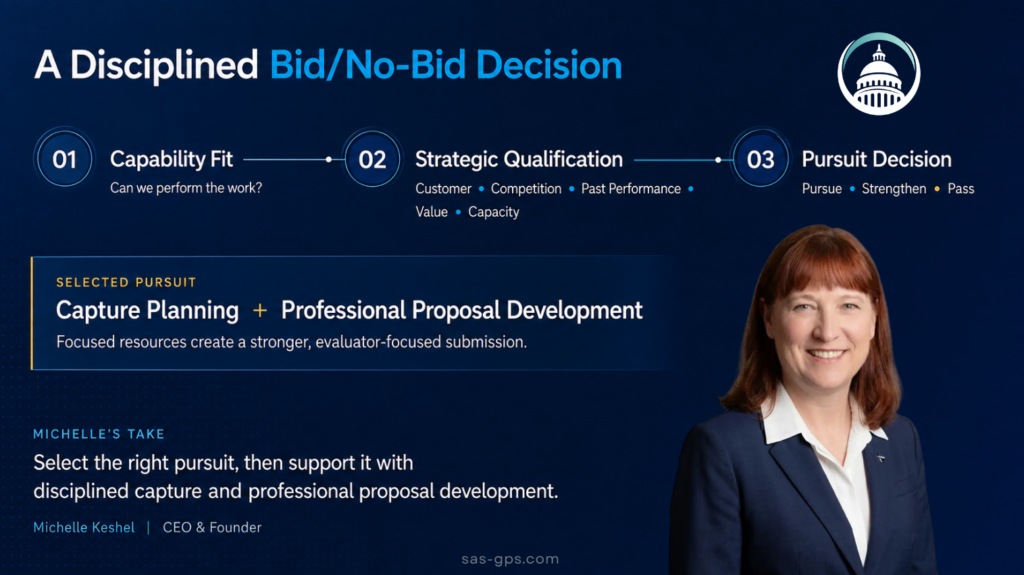
EVERY BID/NO-BID DECISION SHOULD ADDRESS FIVE STRATEGIC AREAS
A disciplined bid/no-bid process evaluates far more than technical capability.
Before committing capture and proposal resources, experienced organizations examine the strategic factors that most directly influence competitive positioning and proposal success.
How Well Do We Understand the Customer?
General familiarity with an agency does not equal meaningful customer intelligence.
Strong capture planning may include:
- Customer engagement
- Industry engagement
- Procurement forecasts
- Sources Sought notices
- Requests for Information
- Competitive analysis
- Acquisition planning
These activities help organizations understand customer priorities before proposal development begins.
Important questions include:
- What problem is the agency trying to solve?
- What operational challenges influence the procurement?
- What has changed since the previous contract?
- Which factors are likely to influence proposal evaluation?
- Where can our solution create measurable value?
The earlier these questions are explored, the stronger the initial proposal strategy becomes.
When detailed customer intelligence is limited, experienced federal proposal consultants can still help evaluate available information, identify assumptions, strengthen positioning, and develop a proposal strategy aligned with the final solicitation.
Does Our Past Performance Support the Opportunity?
Strong past performance is not necessarily the largest contract your organization has performed. It is the experience that best demonstrates your ability to succeed on the specific procurement.
Experienced proposal teams evaluate whether past performance aligns with:
- Scope
- Technical complexity
- Customer environment
- Contract value
- Performance risk
- Evaluation criteria
- Best-value considerations
Potential gaps identified during capture or proposal development may create opportunities to strengthen the pursuit through teaming partners, additional supporting evidence, or a refined proposal strategy.
Professional government proposal development transforms relevant experience into persuasive narratives that reinforce evaluator confidence and reduce perceived performance risk.
Can We Establish a Credible Competitive Position?
Capability alone does not create competitive advantage.
Organizations must evaluate the broader competitive environment, including:
- The incumbent contractor
- Likely competitors
- Customer relationships
- Contract vehicle considerations
- Pricing pressures
- Competitive positioning
- Evidence supporting proposed discriminators
Internal strengths become meaningful differentiators only when they are relevant to the customer’s priorities and supported by credible evidence.
Professional proposal development services help organizations identify which strengths matter most, refine the proposal strategy, develop consistent win themes, and communicate those differentiators throughout the response.
The result is not simply a compliant proposal. It is a proposal that clearly demonstrates best value while increasing evaluator confidence.
BOTTOM LINE
Strong bid/no-bid decisions are built on evidence, not optimism.
Organizations that invest early in capture planning, competitive analysis, customer engagement, and proposal strategy enter proposal development from a stronger position. Professional proposal teams then test, refine, and translate that foundation against the final solicitation.
CRITICAL INSIGHT #3
DOES THE OPPORTUNITY SUPPORT YOUR LONG-TERM BUSINESS STRATEGY?
Winning a federal contract should strengthen the business, not simply increase revenue.
An opportunity may align with your technical capabilities while creating financial, operational, or strategic challenges that outweigh its potential benefits.
Before making a bid/no-bid decision, experienced contractors evaluate questions such as:
- Does the anticipated contract type align with our business model?
- Is the pricing environment realistic and sustainable?
- Can we recruit, onboard, and retain the required workforce?
- Does the period of performance support our long-term growth objectives?
- Will this pursuit strengthen our position in the federal marketplace?
- Does it create strategically valuable past performance or expand access to contract vehicles?
Revenue alone should not determine whether an opportunity deserves pursuit.
Organizations should also consider anticipated margins, transition costs, staffing demands, subcontracting requirements, cash-flow implications, and operational risk before committing significant capture and proposal development resources.
This strategic evaluation is a critical component of capture management and helps ensure that the company pursues opportunities supporting sustainable growth rather than simply increasing proposal volume.
BOTTOM LINE
Successful government contractors evaluate every pursuit as a business investment, not simply as another proposal opportunity.
The strongest pipelines are built on strategic fit, not opportunity volume.
CRITICAL INSIGHT #4
WARNING SIGNS THAT DESERVE ADDITIONAL SCRUTINY
Few opportunities are perfect. However, experienced pursuit teams recognize indicators that suggest additional evaluation is needed before substantial proposal resources are committed.
Leadership should pause and examine opportunities when:
- Customer or program-specific intelligence is limited
- The incumbent appears strongly positioned and no credible displacement strategy has been developed
- Relevant past performance does not closely align with the anticipated evaluation criteria
- Proposed differentiators rely on broad marketing claims rather than measurable evidence
- Contract vehicle or socioeconomic requirements reduce competitiveness
- Key teaming partners have not been finalized
- The pricing environment creates unacceptable performance risk
- Internal subject matter experts have limited availability during the proposal schedule
- Multiple pursuits are competing for the same capture and proposal resources
- The primary justification for bidding is simply that the solicitation appears to match the company’s capabilities
None of these conditions automatically requires a no-bid decision.
Instead, they identify areas where capture intelligence, competitive analysis, executive review, and professional proposal development can determine whether and how the pursuit may be strengthened before or after the solicitation is released.
Organizations that identify these issues early have more time to refine strategy, strengthen customer engagement, establish meaningful discriminators, and improve proposal competitiveness.
Even after RFP release, experienced proposal professionals can assess the final requirements, test assumptions, identify remaining gaps, and help the team determine the strongest available path forward.
BOTTOM LINE
Successful bid/no-bid decisions are rarely driven by a single issue.
They are built through disciplined evaluation of multiple factors that influence competitive positioning throughout the government procurement lifecycle.
CRITICAL INSIGHT #5
PROFESSIONAL PROPOSAL DEVELOPMENT STRENGTHENS THE PURSUIT BEFORE AND AFTER RFP RELEASE
Many organizations assume professional proposal support begins only after the RFP is released. In practice, experienced proposal professionals can add value throughout the pursuit.
Before release, they may help organizations:
- Evaluate available opportunity and customer intelligence
- Identify assumptions and unresolved gaps
- Assess past performance alignment
- Refine positioning and discriminators
- Support responses to Sources Sought notices and RFIs
- Prepare early proposal strategies and content plans
- Anticipate compliance, staffing, graphics, and production requirements
After release, they help teams:
- Test assumptions against the final solicitation
- Analyze instructions and evaluation criteria
- Refine the solution and proposal strategy
- Align past performance with the final requirements
- Develop persuasive, evaluator-focused narratives
- Coordinate proposal graphics that clarify technical information
- Maintain compliance across every volume
- Manage contributors, reviews, production, and submission
- Adapt to changes in requirements while maintaining strategic consistency
Professional government proposal development is not simply document production.
It is the disciplined process of transforming capture intelligence, customer knowledge, competitive analysis, technical expertise, and business strategy into a clear, compliant, persuasive, evaluator-focused proposal.
BOTTOM LINE
Capture planning develops the early positioning and rationale for the pursuit.
Professional proposal development tests, strengthens, and translates that foundation into a compliant, persuasive submission that gives evaluators confidence in the contractor’s ability to perform.
Neither discipline reaches its full potential without the other.
CRITICAL INSIGHT #6
THE HIDDEN COST OF PURSUING EVERY OPPORTUNITY
One of the greatest threats to proposal quality is not a lack of opportunities. It is too many opportunities.
An overloaded pipeline can create the appearance of growth while quietly reducing competitiveness across every pursuit.
When every capability-aligned solicitation becomes an active proposal:
- Capture planning becomes compressed
- Customer engagement declines
- Competitive analysis becomes less thorough
- Proposal schedules become increasingly aggressive
- Subject matter experts are divided across multiple pursuits
- Proposal managers spend more time reacting than planning
- Proposal compliance reviews receive less attention
- Color Team Reviews become rushed or abbreviated
- Proposal production timelines become compressed
- Strategic messaging becomes inconsistent
The result is rarely a lack of effort. More often, it is an excess of effort distributed across too many pursuits.
Selective pursuit management allows organizations to concentrate executive attention, capture resources, proposal expertise, pricing support, and technical leadership where they are most likely to produce competitive submissions.
Winning more federal contracts does not necessarily require writing more proposals. It requires making better pursuit decisions and executing selected opportunities exceptionally well.
KEY TAKEAWAYS
- Capability alignment qualifies an opportunity for further review. It does not automatically justify pursuit.
- Effective bid/no-bid decisions evaluate customer intelligence, competitive positioning, contract economics, strategic value, and organizational capacity.
- Strong capture planning and capture management improve both pursuit decisions and proposal quality.
- Professional government proposal development can strengthen strategy and positioning before or after RFP release.
- Proposal compliance is essential, but competitive differentiation ultimately earns evaluator confidence.
- Focused pipelines allow organizations to devote sufficient attention to capture planning, proposal development, proposal management, pricing, and compliance.
- Winning more federal contracts depends on selecting the right opportunities and executing them with discipline throughout the government procurement lifecycle.
FREQUENTLY ASKED QUESTIONS
What is a government bid/no-bid decision?
A government bid/no-bid decision is a structured evaluation process used to determine whether a federal opportunity warrants investment.
It considers customer intelligence, competitive positioning, past performance, capture planning, pricing, organizational capacity, and long-term business strategy rather than simply whether the company can perform the work.
What factors should influence a bid/no-bid decision?
Experienced government contractors evaluate customer engagement, procurement forecasts, Sources Sought responses, Requests for Information, competitive positioning, evaluation criteria, contract economics, staffing capacity, performance risk, and available proposal resources before committing to a pursuit.
Why is opportunity qualification important?
Opportunity qualification helps organizations concentrate limited capture and proposal development resources on pursuits where they can establish or strengthen a credible competitive position.
Better qualification can lead to stronger proposals, improved resource utilization, and better long-term win rates.
Can proposal consultants help before or after the RFP is released?
Yes. Experienced federal proposal consultants can support organizations before or after the RFP is released.
Before release, they may help assess available intelligence, strengthen positioning, evaluate past performance, identify differentiators, and prepare for Sources Sought notices and RFIs.
After release, they test assumptions against the final solicitation, refine the strategy and solution, maintain compliance, manage proposal development, and create the evaluator-focused submission.
Why is proposal compliance only part of the equation?
Proposal compliance ensures that the submission satisfies solicitation requirements, formatting instructions, page limitations, and applicable provisions of the Federal Acquisition Regulation.
However, compliant proposals still compete against other compliant proposals. Competitive positioning, persuasive messaging, strong technical narratives, relevant past performance, and compelling win themes influence which proposal gives evaluators the greatest confidence.
Work With a Federal Proposal Team That Wins
Successful contractors understand that winning begins long before proposal writing, but professional proposal support remains valuable at every stage of the pursuit.
For more than two decades, SAS-GPS has helped organizations strengthen federal pursuits through early capture and pursuit strategy, government proposal writing, proposal development, proposal management, compliance reviews, pricing support, and final proposal production.
Our entirely in-house team provides expertise in:
- Capture strategy
- Capture management
- Government proposal writing
- Government proposal development
- Proposal management
- Proposal compliance reviews
- Technical writing
- Proposal graphics
- Pricing support
- Color Team Reviews
- Proposal production
- Federal proposal support
Rather than functioning as an outside vendor, SAS-GPS operates as an extension of our clients’ teams.
We help government contractors transform capture intelligence, customer knowledge, competitive positioning, and technical expertise into compliant, persuasive, evaluator-focused proposals that improve competitiveness across the pursuit lifecycle.
Whether you are preparing before an RFP is released or responding to an active solicitation, our team can help strengthen your strategy, solution, positioning, compliance, and final submission.
Contact our team to discuss your next pursuit:
SOURCES
SBA Federal Contracting Guide:
https://www.sba.gov/federal-contracting
FAR Part 15, Contracting by Negotiation:
https://www.acquisition.gov/far/part-15
FAR 15.305, Proposal Evaluation:
https://www.acquisition.gov/far/15.305