| Quick Answer: What Is the Federal RFP Process? The federal RFP (Request for Proposal) process is the sequence of phases a government contractor moves through from initial opportunity identification to final proposal submission. It includes five stages: opportunity identification, pre-RFP capture activity, RFP release and compliance review, proposal development and internal review, and submission. Contractors who understand and actively manage each phase compete with a structural advantage over those who begin their work only when the RFP is published. |
Most federal contracts are not won at the proposal stage. They are won or lost in the weeks and months before the RFP ever drops. Contractors who treat the federal RFP process as a writing exercise miss the phases where competitive positioning actually happens.
This article maps the full timeline, from opportunity identification through final submission, and flags where most scaling contractors lose ground.
What Does the Federal RFP Process Look Like End to End?
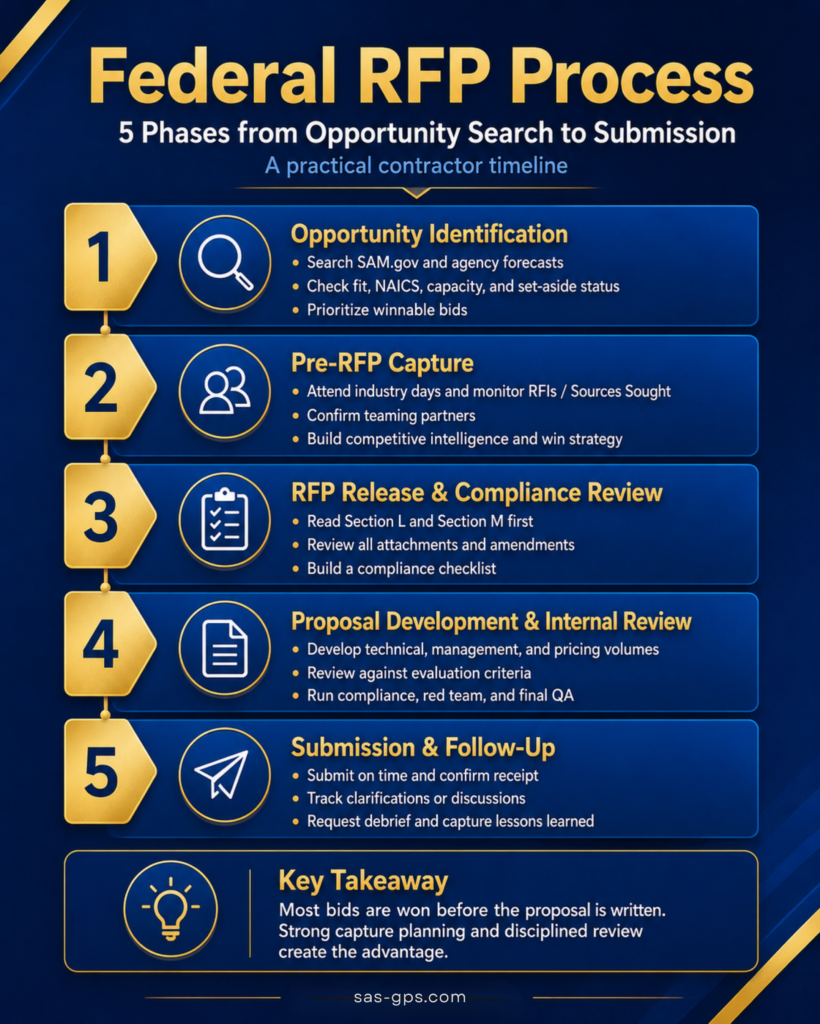
The federal RFP process runs across five phases: opportunity identification, pre-RFP capture, RFP release and compliance review, proposal development, and submission and follow-up. Each phase has its own decision points and its own ways to fall behind.
For contractors managing multiple pursuits simultaneously, the challenge is not understanding the phases; it is executing each one without letting pipeline pressure compress the timeline on high-priority opportunities. Understanding where each phase begins and what it requires is the foundation of a competitive capture planning process. Equally important is knowing which opportunities to pursue in the first place. That filtering discipline is covered in depth in opportunity qualification in government contracting.
Phase 1: Opportunity Identification and Early Qualification
Where to Find Federal Opportunities
SAM.gov (System for Award Management) is the official federal contract opportunity database. Under FAR Part 5, agencies are required to publish solicitations for contracts above $25,000. DoD opportunities appear through both SAM.gov and the Defense Acquisition University procurement forecast tools.
Beyond SAM.gov, agency procurement forecasts, budget justifications, and Sources Sought notices give earlier visibility into what is coming. Contractors who rely solely on RFP releases are already reacting, not positioning.
What to Evaluate Before You Commit
Opportunity qualification at this stage should filter aggressively. The questions to answer are:
- Does this align with our NAICS codes, past performance, and current capacity?
- Who is the incumbent, and what would it take to displace them?
- Is this a set-aside, and are we eligible?
- What is the realistic proposal timeline, and do we have the bandwidth?
Pursuing too many opportunities dilutes effort across all of them. A disciplined qualification filter at Phase 1 protects BD resources for winnable bids.
Phase 2: What Should Contractors Do Before the RFP Drops?
Why the Pre-RFP Window Determines Win Probability
By the time an RFP is released, agencies have often already formed impressions of likely vendors through industry days, RFI responses, and direct engagement. Contractors who have not been part of that pre-solicitation conversation are entering at a disadvantage.
Win probability is largely established before proposal writing begins. The pre-RFP phase is when contractors should be attending industry days, submitting substantive RFI responses, confirming teaming arrangements, and building competitive intelligence on likely competitors. For a structured approach to assessing win probability before committing to a pursuit, the PWIN analysis and price-to-win strategy provides a repeatable model.
What Strong Capture Activity Looks Like in Practice
- Responding to Sources Sought and RFIs with substantive, capability-aligned submissions
- Confirming teaming partners who fill gaps in past performance or technical capacity
- Mapping the evaluation criteria against your known strengths and weaknesses
- Identifying and addressing past performance gaps before the solicitation drops
Contractors who complete this work before RFP release enter Phase 3 with a strategic blueprint. Those who skip it spend Phase 4 writing a proposal while building a strategy simultaneously.
Phase 3: RFP Release and Compliance Review
Reading Section L and Section M Before Anything Else
When the RFP drops, the first two sections to read are Section L (instructions to offerors) and Section M (evaluation criteria). Section L tells you exactly what to submit, in what format, and in what sequence. Section M tells you how the agency will score it.
Every proposal decision, including what to emphasize, how to structure volumes, and how much page space to allocate, should trace back to Section M. Contractors who write to their own strengths rather than to the evaluation criteria frequently submit compliant proposals that score poorly.
Questions and Amendments: Why They Matter
The Q&A window is a strategic opportunity. Well-crafted questions can clarify ambiguous requirements, surface scope details that inform pricing, and occasionally shape how the agency frames the final amendment. Contractors who submit no questions leave competitive intelligence on the table.
Monitor all amendments closely. A scope change in Amendment 002 can invalidate a technical approach already in development.
Phase 4: Proposal Development and Internal Review
Structuring Your Proposal Timeline
A realistic proposal timeline works backward from the submission deadline. For most competitive federal proposals, the schedule should include these steps in order:
- Kickoff and outline review (Day 1-2 after RFP release)
- Draft development by volume (Day 3 through approximately 60% of the available timeline)
- Internal compliance review against Section L (rolling throughout development)
- Red team review, with sufficient time to incorporate feedback before final draft
- Final edit and formatting (last 10-15% of the available timeline)
- Submission prep and volume check (day before deadline)
Proposals developed without a written timeline tend to compress the review phases. A red team scheduled two days before submission cannot do its job.
Red Team and Compliance Review Before Submission
A compliance matrix that maps every Section L requirement to the corresponding proposal section is the minimum quality gate before any federal submission. A red team review adds the evaluator’s perspective: does this proposal actually answer what the agency is asking, in a way that earns the score? Contractors who invest in government proposal writing services typically benefit most at this phase, where external reviewers catch compliance gaps and scoring weaknesses that internal teams miss after weeks of close work on the same draft.
Phase 5: Submission and What Comes Next
Submit through the designated portal, depending on the solicitation instructions. Confirm receipt and retain the submission confirmation. Late submissions are typically rejected regardless of the reason.
After submission, the active work is not over. Track the stated evaluation timeline. If the agency enters discussions or requests clarification, response windows are often short. Contractors who stay engaged post-submission and respond quickly to clarification requests maintain a competitive edge through award.
After the Decision: Debriefs, Feedback, and After-Action Review
Your Right to a Post-Award Debrief
Most contractors do not use this right, and it is one of the most recoverable gaps in federal BD practice. Under FAR 15.506, unsuccessful offerors may request a post-award debriefing from the Contracting Officer. The request must be submitted in writing within three business days of receiving notification that your proposal was not selected.
The CO is required to provide the evaluation of your proposal’s significant strengths and weaknesses, the overall evaluated cost or price, and the rationale for the award decision. This is not a courtesy; it is a right, and the information it surfaces is often more actionable than anything your team identified internally during the proposal process.
Pre-award debriefs are also available under FAR 15.505 for offerors excluded from the competitive range, with the same three-business-day request window. Contractors who request debriefs consistently develop a clearer picture of how target agencies evaluate proposals over time.
Internal After-Action Review
Win or lose, every proposal should close with a structured internal review. The goal is not to assign blame but to extract intelligence that sharpens the next submission. A basic after-action framework covers three questions:
- What did the proposal get right, and why? Identify the sections that scored well or received positive debrief feedback and document what made them effective.
- Where did it fall short, and when did that become apparent? Determine whether the gap was a capture failure, a writing failure, or a pricing failure. Each requires a different fix.
- What process broke down? Identify timeline compression, missed review steps, or late teaming decisions that weakened the final product and build a correction into the next pursuit.
Contractors who treat every submission as a data point rather than a verdict build compounding advantages over time. The debrief and the after-action review are where that data lives.
The Timeline Mistakes That Cost Contractors Bids
- Starting capture activity at RFP release instead of months earlier
- Skipping the Q&A window and missing scope clarifications
- Reading Section L but not Section M before writing begins
- Scheduling the red team too close to the submission deadline
- Treating submission as the end of the process rather than a milestone
Each of these mistakes is recoverable on the next opportunity. Contractors who build structured processes for each phase stop repeating them.
| Key Takeaways The federal RFP process has five phases; most competitive advantage is built in Phases 1 and 2, before the RFP is releasedOpportunity qualification should filter aggressively; fewer, better-qualified pursuits consistently outperform high-volume BD approachesSection L defines what to submit; Section M defines how it will be scored; both must inform every proposal decisionThe Q&A window is a strategic tool, not an administrative formalityA written proposal timeline that protects review phases is what separates competitive submissions from compliant onesPost-submission engagement matters; agencies enter discussions and request clarifications on short timelinesUnder FAR 15.506, unsuccessful offerors have the right to request a post-award debrief within three business days of notification; most contractors do not use itAn internal after-action review after every submission, win or loss, builds compounding improvements across the BD process |
Work With a Federal Proposal Team That Wins
Whether you have an RFP in hand today or you are building your federal strategy for the year ahead, SAS-GPS is ready to help. We provide end-to-end proposal development, compliance review, and pricing support for federal contractors across all industries.
Learn more about our government proposal writing services or contact our team to discuss an active opportunity.
Sources
SAM.gov: Federal Contract Opportunities
FAR Part 5: Publicizing Contract Actions
FAR 15.305: Proposal Evaluation