The government contracting environment is undergoing a dramatic transformation. What worked five years ago—boilerplate proposals, lowest-price bids, and status quo teaming—no longer guarantees results. The procurement process is changing quickly with evolving federal mandates, new technologies, and a sharpened focus on risk, equity, and sustainability.
These shifts represent risk and opportunity for contractors operating in federal procurement markets. Agencies seek partners who comply with today’s requirements and anticipate tomorrow’s. Contractors who recognize the trends shaping future acquisition priorities can adapt more quickly, improve their positioning, and gain a long-term competitive advantage.
In this article, we explore five key government procurement trends that are actively reshaping government buying and how contractors must respond. Each section highlights a significant shift and provides clear, actionable strategies to stay ahead of the curve.
Whether you’re a seasoned prime or a growth-focused small business, understanding these trends is essential for winning in tomorrow’s procurement landscape.
Trend 1: Cybersecurity and Zero Trust Are Now Baseline Requirements
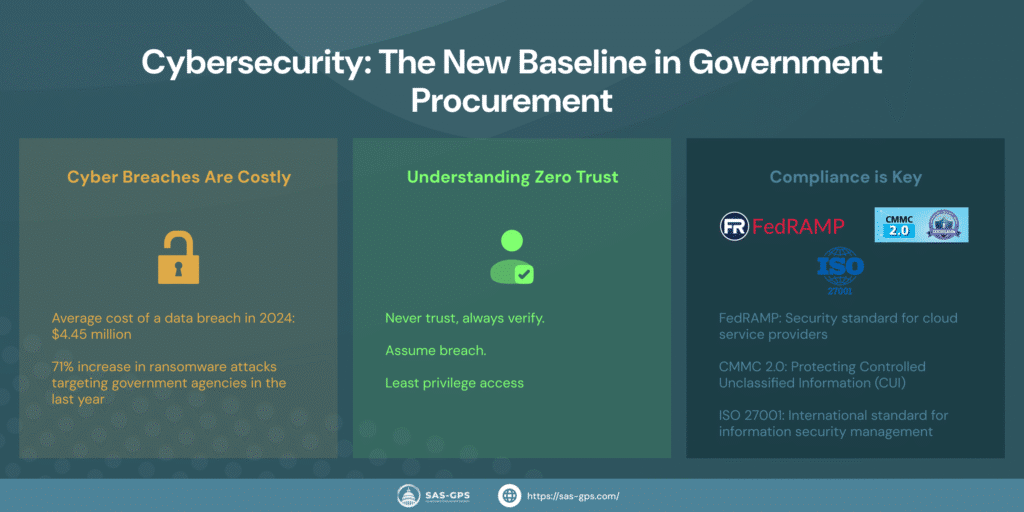
Over the past five years, the federal government has clarified that cybersecurity is not just an IT issue—it’s a procurement priority. Agencies embed cybersecurity standards directly into solicitations, and contractors across all sectors are expected to comply.
This trend has been accelerated by high-profile breaches, supply chain vulnerabilities, and presidential directives, such as Executive Order 14028, which mandates the adoption of Zero Trust Architecture (ZTA) across federal networks. In parallel, agencies are increasingly demanding FedRAMP authorization, NIST 800-171 compliance, and cyber risk disclosures, even in contracts unrelated to IT infrastructure.
What This Means for Contractors
Cybersecurity maturity is now part of proposal evaluation. It’s no longer a niche section buried in a management volume—it’s a deciding factor. Contractors without documented cyber practices, formal frameworks, or third-party validations risk being scored lower or outright disqualified.
How to Stay Ahead
- Invest in Cyber Certifications and Frameworks
- Pursue FedRAMP, CMMC 2.0, and ISO 27001 if applicable.
- Ensure systems and teams follow NIST 800-53/171 frameworks for controlled unclassified information (CUI).
- Embed Cyber Practices Into Proposals
- Don’t just say you follow best practices—prove it.
- Include details about encryption, monitoring, incident response, and secure development lifecycles.
- Train Proposal Teams on Cyber-Influenced Evaluations
- Proposal writers and solution architects must understand how cybersecurity language influences scoring.
- Proposal writers and solution architects must understand how cybersecurity language influences scoring.
- Tailor Cyber Strategy to Each Agency
- Departments like DHS, DoD, and VA have distinct cyber policies and expectations. Show that you understand the specifics.
- Departments like DHS, DoD, and VA have distinct cyber policies and expectations. Show that you understand the specifics.
Example: A contractor bidding on a civilian agency task order lost the award despite a competitive price and strong past performance because its cyber section lacked the detail required for compliance. The winner? A vendor that embedded Zero Trust principles into every part of their solution, from user authentication to network segmentation.
In today’s procurement climate, cybersecurity isn’t a bonus—it’s the barrier to entry. Contractors must elevate their posture or risk being left behind.
Trend 2: Closely Track SBA Rule Changes and Socioeconomic Shifts
With the rescission of Executive Order 13985 in early 2025, the federal government has shifted its procurement approach away from equity-centered mandates. However, small-business goals and SBA-driven policy changes remain in place—and continue to shape how agencies structure high-value contracts.
Instead of DEI requirements or equity scoring, the focus has shifted back to compliance with Small Business Administration (SBA) regulations, which continue to guide how agencies meet small business targets across categories such as 8(a), HUBZone, SDVOSB, and WOSB.
What This Means for Contractors
Even without equity mandates, socioeconomic factors still influence awards. Agencies must meet statutory small business participation goals, and contractors are expected to align with them through teaming, subcontracting, or direct eligibility.
SBA is actively updating:
- Size standards for eligibility.
- 8(a) program criteria in response to recent court challenges.
- Certification rules and protest processes.
These changes directly impact your eligibility, teaming strategy, and competitive positioning.
How to Stay Ahead
- Monitor SBA Regulatory Updates Closely
Subscribe to SBA alerts or work with consultants to stay ahead of rule changes, especially size recertifications and eligibility revisions. - Strengthen Strategic Partnerships
Mentor-protégé arrangements and joint ventures remain a legal and effective way to pursue high-value contracts under the new rules. - Tailor Socioeconomic Strategies to Current Thresholds
Show evaluators how your team meets current SBA guidelines—not outdated EO criteria—and how that strengthens your proposal.
Example: A mid-sized IT contractor recently revised its teaming strategy to prioritize HUBZone-certified firms in response to the SBA’s updated guidance on geographic eligibility. That move helped the team qualify for a previously inaccessible task order—and win. With equity mandates removed, the smart focus now is SBA alignment. Contractors who stay on top of regulatory shifts and structure their bids accordingly will remain well-positioned in the evolving procurement landscape.
Trend 3: Automation and AI Are Reshaping How Agencies Evaluate Proposals
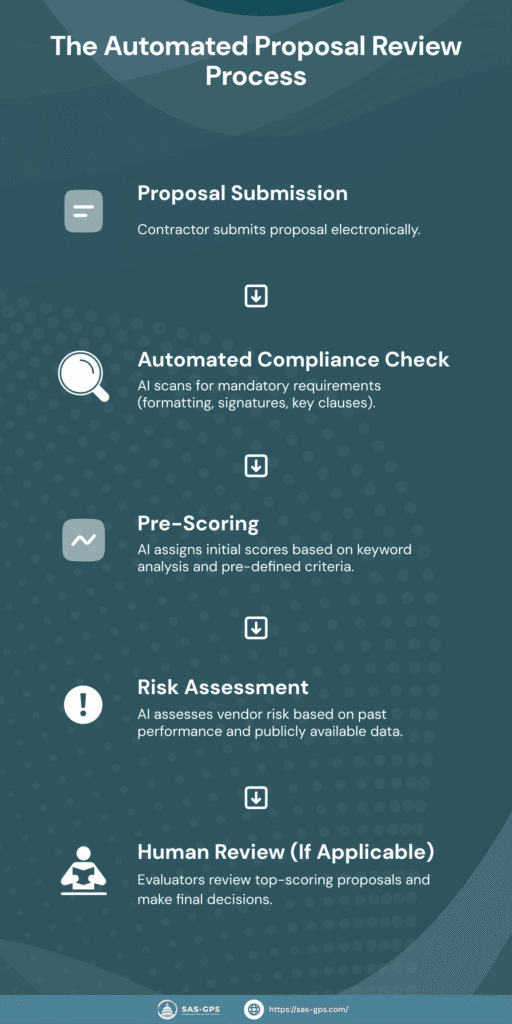
Artificial intelligence and automation aren’t just trends—they’re becoming embedded into the government’s procurement machinery. From automated compliance screening to risk modeling, AI is changing how proposals are reviewed, decisions are made, and contractors need to write.
Agencies are increasingly using platforms like Symphony, PRISM, and internally built tools that apply machine learning to:
- Pre-score proposals based on predefined criteria.
- Flag compliance issues automatically.
- Assess vendor risk based on past performance data and publicly available indicators.
This means software could screen your proposal before a human reads it.
What This Means for Contractors
As more initial evaluations are automated:
- Structured, scannable content becomes essential.
- Compliance errors previously caught during live reviews are now subject to immediate disqualification.
- Ambiguity, jargon, or misplaced content confuses algorithms—and hurts your score.
This impacts everything from formatting and volume structure to how you present pricing rationale and technical narratives.
How to Stay Ahead
- Use Standardized Proposal Templates
- Consistent headers, sectioning, and formatting help AI systems map content correctly to evaluation criteria.
- Avoid creative formats that stray from RFP instructions.
- Mirror Evaluation Criteria Directly
- Use keywords and phrasing from the solicitation. Many systems use natural language processing (NLP) to align proposal content with scoring rubrics.
- Avoid Ambiguous or Fluffy Language
- Statements like “cutting-edge” or “industry-leading” carry no value to AI systems.
- Use measurable, factual, outcome-based statements.
- Pre-Test Proposals with Internal Automation Tools
- Some contractors now use in-house checkers to simulate what AI tools might flag—noncompliance, missing data, vague claims.
Example: A professional services firm failed to include specific language from Section L of the RFP. An automated review flagged their proposal as noncompliant. Despite having strong content, they were excluded from scoring.
Contractors must now write for two audiences: the human evaluator and the machine. Success lies in clarity, structure, and the strategic use of language that satisfies both.
Trend 4: Best Value and Risk-Aware Evaluations Are Dominating Source Selections
The era of lowest-price wins is fading, especially for complex or mission-critical procurements. Agencies are increasingly shifting to Best Value Trade-Off and Lowest Risk, Technically Acceptable evaluation models. Price is still important, but technical strength, risk mitigation, and mission alignment now carry greater weight in many procurements.
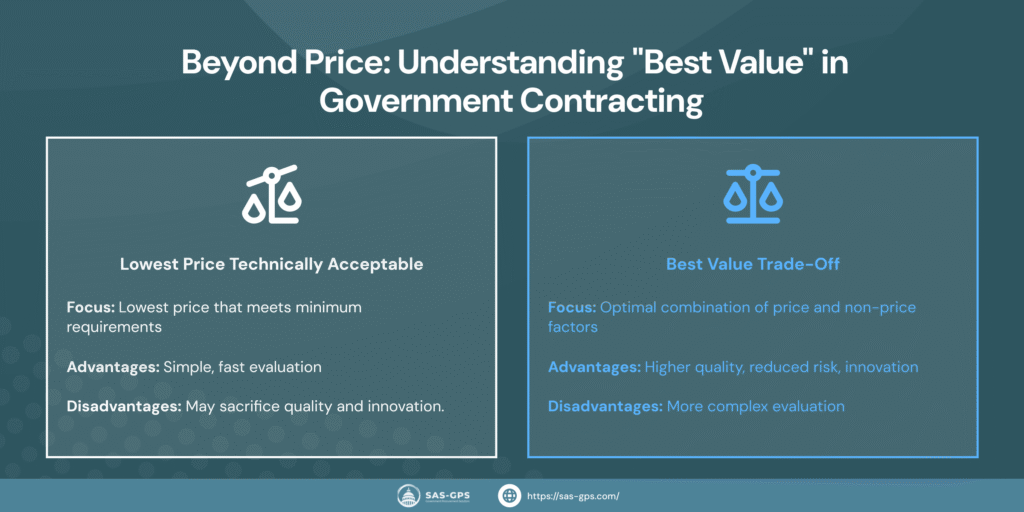
Evaluators are actively looking for:
- Deep understanding of agency operations.
- Solutions that reduce implementation risk.
- Proven performance in similar environments.
- Agility and contingency planning.
This applies across sectors, from IT modernization and cybersecurity to facility support, logistics, and consulting. Contractors can no longer afford to rely solely on price competitiveness.
What This Means for Contractors
You can no longer assume that a compliant proposal and competitive pricing are enough. You’ll likely fall short in the technical and management scoring without a clear story explaining how your solution reduces risk and maximizes value.
Common pitfalls:
- Overemphasizing credentials and underexplaining outcomes.
- Underdeveloped risk mitigation strategies.
- Failing to connect your offering directly to the agency’s mission.
How to Stay Ahead
- Develop Solution-Centered Win Themes
- Go beyond qualifications. Focus on what outcomes your solution will achieve, not just how it works.
- Go beyond qualifications. Focus on what outcomes your solution will achieve, not just how it works.
- Build Detailed Risk Mitigation Plans
- Don’t just say “low risk.” Demonstrate it through backup systems, cross-trained staff, contingency plans, and timeline protections.
- Don’t just say “low risk.” Demonstrate it through backup systems, cross-trained staff, contingency plans, and timeline protections.
- Strengthen Past Performance Relevance
- Highlight past work that is highly similar in scope, mission, and complexity, not just impressive names.
- Highlight past work that is highly similar in scope, mission, and complexity, not just impressive names.
- Quantify Value
- Instead of vague claims, use actual performance metrics:
- “Reduced downtime by 22% across 18 locations.”
- “Delivered system rollout 14 days ahead of schedule, saving $120K in project costs.”
- Instead of vague claims, use actual performance metrics:
Example: A defense contractor increased its award rate by 28% after embedding formal risk tables in every proposal, showing threat likelihood and mitigation measures for each performance phase.
Best value awards go to firms that promise performance and prove they will deliver securely and reliably, with lower risk than the competition.
Trend 5: Sustainability and Climate Resilience Are Becoming Procurement Priorities
Environmental responsibility is no longer just a “nice to have” in government contracts—it’s becoming a scoring factor. Driven by Executive Order 14057, the Biden administration has directed federal agencies to prioritize sustainability, carbon reduction, and climate resilience in direct contracts and supply chain evaluations.
The GSA, DoD, and EPA have already begun integrating environmental performance into procurement scoring systems, requiring vendors to report on emissions, energy use, and environmental impact.
This shift is affecting contracts across sectors beyond the obvious ones like construction and energy. IT providers, logistics firms, and even professional services are now expected to align with climate goals and responsible resource use.
What This Means for Contractors
Agencies want to partner with vendors who support their climate and ESG (environmental, social, governance) initiatives. Firms that cannot demonstrate sustainable practices may see reduced competitiveness or be excluded from future frameworks.
How to Stay Ahead
- Document Your Sustainability Measures
- Include environmental certifications (LEED, ISO 14001, ENERGY STAR).
- Outline your organization’s carbon tracking, recycling, or green purchasing programs.
- Tailor Responses to the Agency’s Mission
- If responding to a DoD RFP, tie sustainability efforts to resilience and operational readiness.
- For civilian agencies, emphasize emissions reductions and community impact.
- Partner with Environmentally Focused Subs
- Many small and disadvantaged firms have strong green programs. Use their capabilities to strengthen your response.
- Track and Report ESG Metrics
- More agencies are requesting emissions data, water use, and carbon offsets. Build the capability to track and report these.
Example: A logistics firm won a FEMA contract in part due to its hybrid fleet strategy and established carbon reporting system, which were highlighted as technical strengths.
Sustainability is no longer optional. The future of federal procurement favors contractors who align with climate policy and show measurable progress.
Conclusion: Stay Proactive, Not Reactive
The federal procurement landscape is evolving rapidly, and competent contractors are evolving alongside it. The trends shaping tomorrow’s bids are already here: cybersecurity as a core evaluation factor, diversity and small-business integration, evaluation automation, risk-aware best-value scoring, and sustainability-driven purchasing.
Here’s the reality: If your organization isn’t adjusting proactively, you’re falling behind competitors who are.
To stay ahead:
- Monitor policy shifts and agency-specific initiatives.
- Train your proposal teams on trend-driven writing and compliance best practices.
- Integrate new expectations—such as cyber, ESG, and automation readiness—into your solutions now, not later.
Winning in the future means preparing before the RFP drops, aligning with agency priorities, and demonstrating to evaluators that you’re not just ready for today, but also built for tomorrow.
In modern government procurement, those who wait reactively often lose.
Are you ready for what’s next in federal procurement?
The rules are changing, and staying competitive means staying ahead of cybersecurity mandates, small business shifts, AI evaluation models, and climate-driven contracts.
At SAS-GPS, we help contractors position for what’s coming, not just what’s current.
Before your next RFP hits the street, let’s talk strategy, positioning, and performance.
👉 Contact SAS-GPS for a future-ready consultation →