Federal contractors often focus most of their effort on proposal writing. However, experienced contractors know that capture planning in government contracting often determines whether a proposal will be competitive long before the request for proposal (RFP) appears. For companies that use government proposal writing services to compete on major bids, starting the capture process early can help separate competitive submissions from reactive ones.
Many winning teams have already shaped their positioning months before the solicitation is released. They understand the agency’s priorities, build strategic teaming relationships, and align their past performance with the expected evaluation criteria, so they are ready to execute a bid effectively once the government releases it.
Capture planning does not replace proposal development. Instead, it prepares companies to submit stronger proposals once the opportunity reaches the formal procurement stage. For contractors pursuing multi-million dollar opportunities, companies that start early can have a significant advantage.
What Capture Planning Means in Government Contracting
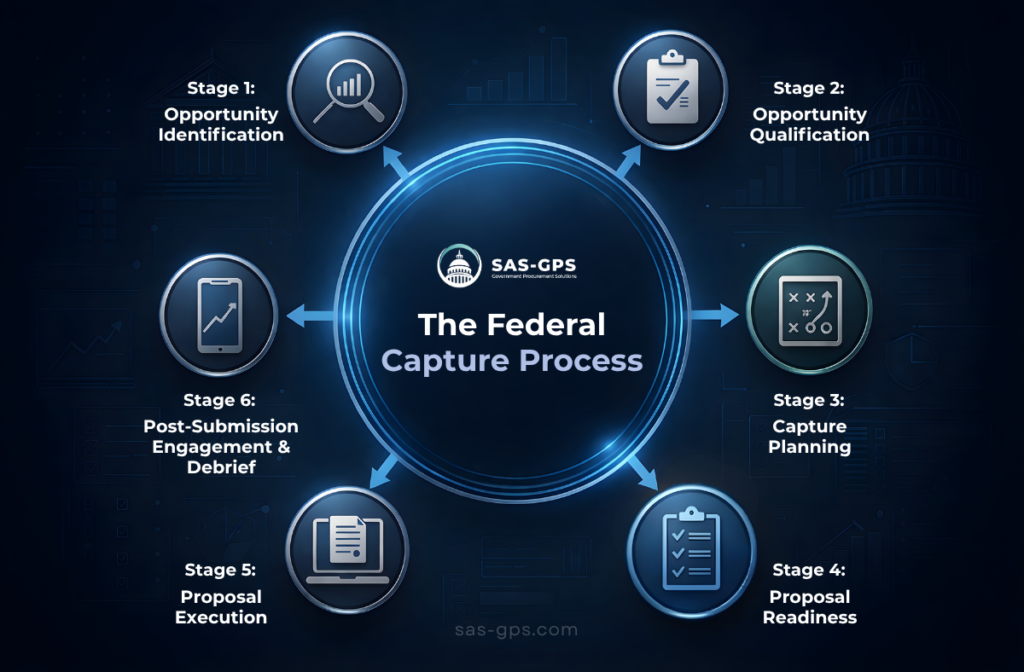
Capture planning in government contracting is the structured process of preparing for a federal opportunity before the solicitation is released. It typically begins when an organization identifies a potential opportunity through agency forecasts, industry engagement, or market intelligence. Capture planning focuses on positioning the contractor to compete effectively once the formal procurement begins.
Typical capture planning activities include:
-
- Identifying and qualifying the opportunity
- Analyzing agency priorities and mission needs
-
- Aligning past performance with anticipated requirements
-
- Building a strategic team of partners or subcontractors
-
- Researching likely competitors
-
- Conducting price-to-win analysis and proposal pricing research
- Preparing for the proposal phase
Many contractors refer to this process as government capture strategy. While large contractors often maintain dedicated capture teams, small and mid-sized businesses frequently approach capture more informally. Even so, having disciplined capture planning, or using experienced capture planning services, can significantly improve win probability.
Why the Federal Procurement Environment Is Becoming More Competitive
Federal procurement has become more structured and competitive in recent years. Agencies increasingly rely on large contract vehicles and multi-award contracts to manage procurement efficiently. These vehicles allow agencies to issue task orders among pools of pre-qualified contractors. As a result, competition is often intense even for relatively modest task orders.
Several trends are shaping the current federal acquisition environment.
First, agencies are expanding the use of contract vehicles such as GWACs, multi-award IDIQ contracts, and best-in-class vehicles. These vehicles streamline procurement but concentrate competition among approved vendors.
Second, proposal volumes have increased significantly. Many solicitations now receive dozens of proposals, and some receive hundreds.
Third, evaluation criteria emphasize past performance relevance, management maturity, and risk reduction. In this environment, companies that begin planning only after the RFP appears often struggle to differentiate themselves.
Key Signals That an Opportunity Is Moving Toward Solicitation
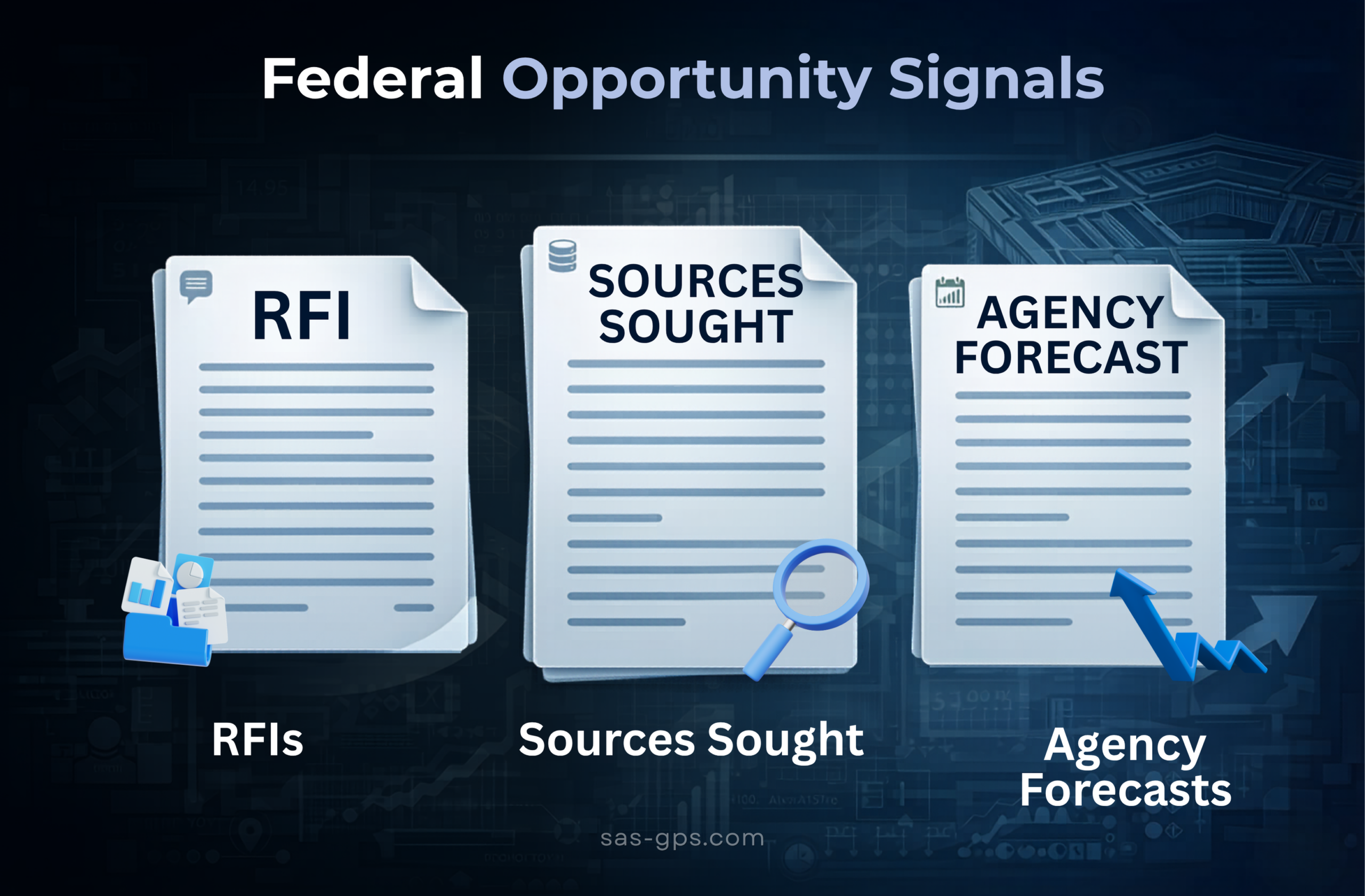
Federal opportunities rarely appear without warning. Agencies usually release multiple signals as they prepare for a procurement. Recognizing these signals is an important part of capture planning in government contracting.
The most common indicators are as follows:
-
- Requests for Information and Sources Sought notices allow agencies to gather industry input and assess market capabilities. These notices often provide early insight into scope, evaluation priorities, and contract structure.
-
- Agency procurement forecasts provide visibility into anticipated contract actions months or even years in advance. Reviewing these forecasts regularly can help contractors identify opportunities before formal acquisition activity begins.
-
- Industry days and market research engagements provide direct insight into agency priorities and program objectives. Monitoring these signals allows contractors to begin capture planning early rather than reacting once the solicitation is released.
How Contract Vehicles Shape Opportunity Pipelines
Contract vehicles play a major role in modern federal procurement. Many agencies now route significant portions of their procurement activity through structured contract vehicles. For contractors, understanding these vehicles is essential for building a healthy opportunity pipeline.
Government-wide acquisition contracts allow agencies to procure complex services from pools of approved vendors. Examples include enterprise IT and professional services vehicles. Multi-award IDIQ contracts allow agencies to issue task orders among pre-qualified contractors over a defined period. Agency-specific vehicles often support long-term mission programs and can generate significant revenue for contractors who hold positions on those vehicles.
Because these vehicles concentrate competition among approved vendors, contractors must differentiate themselves not only to win a place on the vehicle but also to compete effectively for task orders. Understanding how agencies use these vehicles is an important part of capture planning and opportunity qualification.
Why Capture Planning Still Requires Strong Proposal Development
Capture planning prepares a contractor to compete. Proposal execution ultimately determines the outcome of the competition. Even the best-positioned teams must still submit compliant and persuasive proposals that align with the agency’s evaluation criteria.
Successful proposals typically require:
-
- Detailed compliance matrices
- Structured technical narratives
- Relevant past performance examples
- Realistic pricing strategies
- Careful submission coordination
Companies often rely on experienced proposal development services to manage these activities and ensure that the final submission meets all solicitation requirements. Capture planning creates the opportunity to compete effectively. Proposal development transforms that positioning into a competitive submission.
A Practical Capture Planning Framework for Federal Contractors
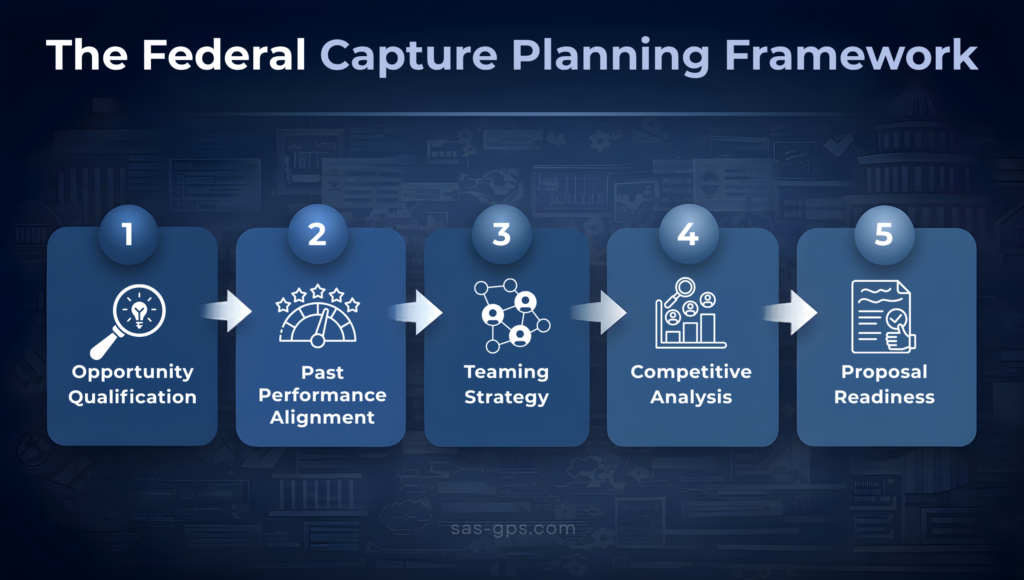
Small and mid-sized contractors can implement capture planning using a structured framework built around six core steps.
Step one is opportunity qualification. Contractors should evaluate whether the opportunity aligns with their capabilities, past performance, and strategic goals.
Step two is past performance alignment. Companies should assess whether they can demonstrate relevant experience that matches the expected evaluation criteria.
Step three is teaming strategy. Contractors may need to identify partners who provide complementary capabilities or additional past performance.
Step four is competitive analysis. Understanding likely competitors helps contractors refine their positioning and messaging, a core component of competitive analysis for government contracts.
Step five is price-to-win analysis. Contractors should research likely competitor pricing and assess the agency’s budget expectations to develop a realistic and competitive pricing strategy. Early price-to-win research helps avoid the common mistake of building a strong technical proposal that loses on cost.
Step six is proposal readiness. Teams should prepare proposal infrastructure early, including compliance planning and content planning. Many organizations also engage external capture management services and proposal strategy consulting to guide this process and ensure opportunities are evaluated strategically.
Key Takeaways
-
- Capture planning in government contracting begins months before the RFP is released, not after.
- Early positioning on agency contract vehicles improves task order competitiveness.
- A six-step framework guides small and mid-sized contractors through structured capture planning.
- Monitoring RFIs, Sources Sought notices, and agency forecasts provides advance warning of upcoming opportunities.
- Strong proposal development translates the capture strategy into a compliant, competitive submission.
- Working with experienced capture management services or proposal strategy consultants improves win probability on high-value federal bids.
Strengthen Your Federal Proposal Strategy
Winning federal contracts requires more than writing a proposal after the RFP appears. The most successful contractors combine early capture planning with structured proposal development and a disciplined approach to compliance. SAS-GPS supports federal contractors pursuing substantial federal opportunities through capture planning services, government proposal writing services, and compliance reviews. Contact our team to discuss an upcoming opportunity or learn more about our proposal development services.