Federal evaluators follow a defined process. Before they score your technical approach, before they weigh your past performance, before anyone reads a single sentence of your narrative, someone on the evaluation team checks whether your proposal responds to every requirement in the RFP.
That check is not informal. Agencies use a structured review to verify compliance, and contractors who submit without one risk immediate disqualification, regardless of how strong their solution is.
A proposal compliance matrix is the tool that keeps that from happening. It is one of the most basic elements of a well-managed proposal process, and one of the most frequently skipped.
Why Federal Proposals Get Disqualified Before They Are Read
Federal agencies receive proposals under strict rules governed by the Federal Acquisition Regulation (FAR). Under FAR Part 15, contracting officers evaluate proposals against the factors and sub-factors stated in the solicitation. If a proposal fails to address a required element, the agency has grounds to reject it as non-responsive, often without further review.
The most common administrative failures that lead to early disqualification include: missing required sections, exceeding page limits, omitting required certifications or representations, failing to address evaluation criteria, and submitting in a format the RFP does not permit.
None of these are substantive errors. They are process failures. And they are almost entirely preventable.
What Is a Proposal Compliance Matrix
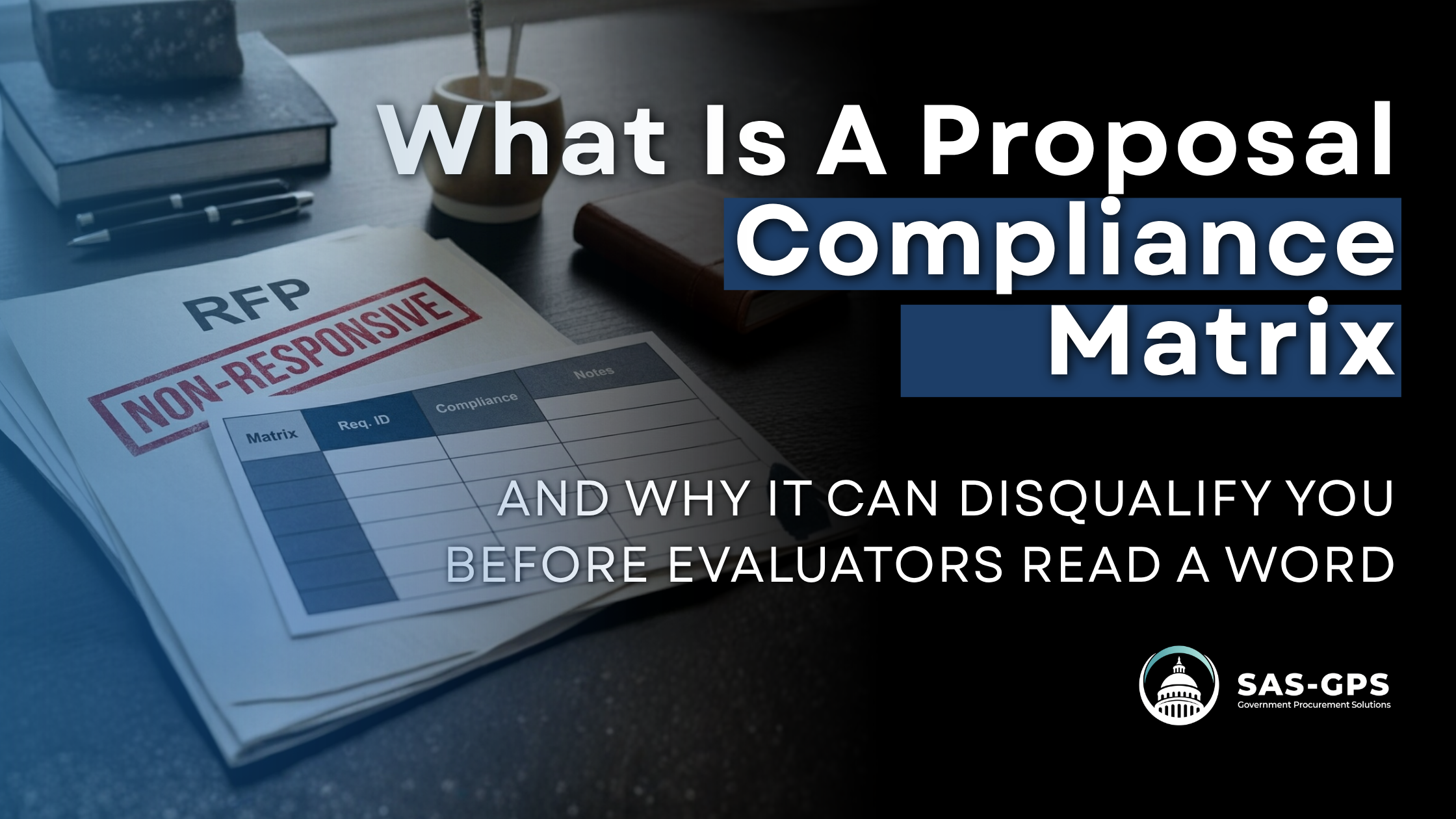
A proposal compliance matrix is a document that maps every requirement in an RFP to a specific location in your proposal. It is typically structured as a table with three core elements: the RFP requirement (cited by section and page), the compliance status (addressed or not addressed), and the corresponding location in your proposal (volume, section, page).
The matrix serves two functions. During development, it acts as a checklist that keeps the proposal team aligned with the solicitation. At submission, it can be included as a standalone deliverable that makes it easier for evaluators to confirm your proposal is responsive.
Some RFPs may even require contractors to submit a compliance matrix as part of the proposal package. Even when it is not required, including one signal organizational discipline reduces friction for evaluators, which can work in your favor.
What a Compliance Matrix Actually Covers
A well-built compliance matrix maps requirements across the full solicitation, not just the Statement of Work. The sections that most often contain hidden requirements include:
-
- Section L (Instructions to Offerors): Page limits, font requirements, file formats, volume structure, submission deadlines, and any required certifications.
-
- Section M (Evaluation Factors): Every factor and sub-factor that evaluators will score, including any mandatory criteria stated as pass/fail.
-
- Statement of Work or Performance Work Statement: Technical and operational requirements that must be addressed in your technical volume.
-
- Contract Clauses and Representations: Required certifications, representations, and acknowledgments that must be completed and submitted.
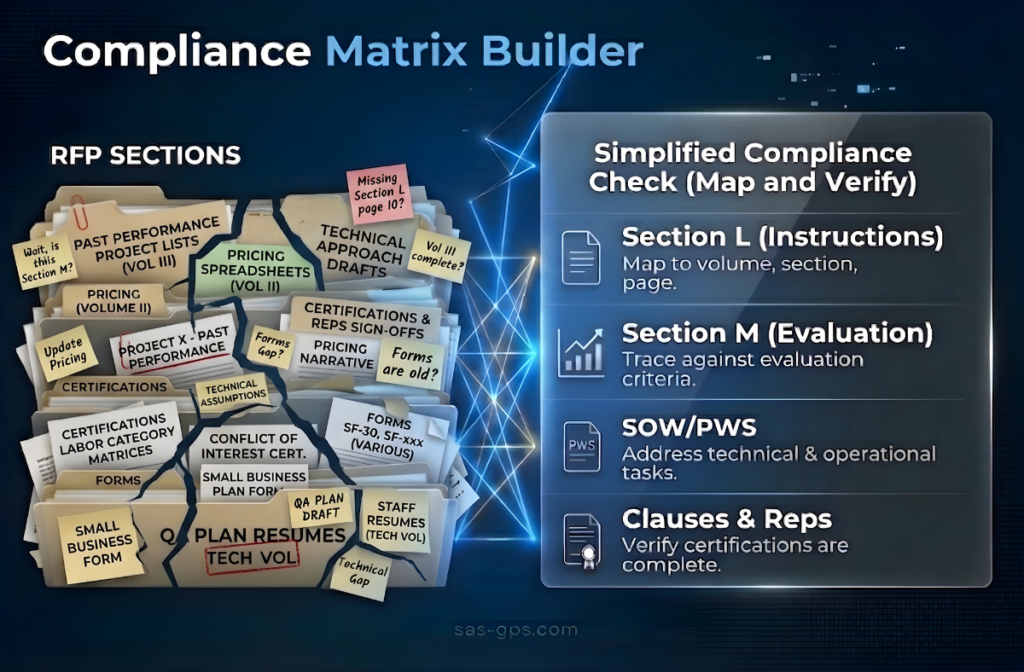
Compliance reviewers who only check against Section L frequently miss Section M requirements, which are evaluation criteria, not instructions. Missing a sub-factor in your technical approach is not a formatting error. It is a content gap that evaluators will score against you.
How the Compliance Matrix Fits Into Proposal Development
The compliance matrix is not a final-stage document. It should be built when the proposal team first receives the RFP and updated continuously as the proposal develops.
The standard workflow looks like this:
-
- RFP release: Build the initial compliance matrix from Sections L and M and the SOW/PWS.
-
- Kickoff: Distribute the matrix to all team members so each person knows exactly what they are responsible for addressing or gathering.
-
- Pink team/draft review: Use the matrix to verify all requirements are addressed at the section level, not just generally referenced.
-
- Red team: Cross-reference the matrix against the full draft to confirm every requirement maps to specific content with a clear page location.
-
- Final review: Conduct a final compliance check before submission, treating the matrix as a pre-flight checklist.
This is the process that experienced federal proposal writing teams use to prevent compliance failures from surfacing at review stages when they are most expensive to fix.
What Happens Without One
Proposals written without a compliance matrix tend to suffer from the same set of problems: sections that respond to the wrong requirements, evaluation sub-factors left unaddressed, and formatting errors that only surface at final review.
The risk is not limited to disqualification. Even proposals that clear the administrative review threshold can score poorly if evaluators find they have to search for responses to required criteria. Evaluators are not required to infer compliance. If the response is not clearly tied to the requirement, many will score it as if it is missing.
Proposals that struggle with compliance often also struggle with the broader patterns that drive federal proposal failures, including weak win themes, misaligned pricing, and poor Section M alignment.
Key Takeaways
-
- A proposal compliance matrix maps every RFP requirement to a specific location in your proposal, preventing administrative disqualification and scoring gaps.
-
- Evaluators under FAR Part 15 assess proposals against stated factors; an unaddressed requirement is a scoreable deficiency, not just a formatting oversight.
-
- The matrix should be built at RFP release, not at final review. Catching gaps late is expensive. Catching them early is a process advantage.
-
- Sections L and M are both essential sources for the matrix. Many teams over-index on Section L and miss evaluation sub-factors in Section M.
-
- Including a compliance matrix in your submission can reduce evaluator friction and signal organizational discipline, even when it is not required.
Work With a Federal Proposal Team That Wins
Whether you have an RFP in hand today or you are building your federal strategy for the year ahead, SAS-GPS is ready to help. We provide end-to-end proposal development, compliance review, and pricing support for federal contractors across all industries.
Learn more about our government proposal writing services or contact our team to discuss an active opportunity.
Sources
FAR Part 15 — Contracting by Negotiation | acquisition.gov
FAR 15.305 — Proposal Evaluation | acquisition.gov
FAR 15.204 — Contract Format (Sections L and M) | acquisition.gov