Pursuing a $1M+ federal contract is not routine business development. It is a capital allocation decision.
Every serious pursuit consumes pricing resources, capture management time, proposal production labor, subcontractor coordination, and executive oversight. For growth-stage and mid-size government contractors, one poorly chosen bid can strain indirect rates, exhaust proposal teams, and divert focus from higher-probability opportunities.
This is where disciplined PWIN analysis and price-to-win strategy become essential.
Effective go/no-go decision support requires more than optimism, incumbent familiarity, or informal agency engagement. It requires structured win probability analysis grounded in the same evaluation framework agencies use to make award decisions.
For larger federal bids, probability must be documented, not assumed.
What Is PWIN Analysis in Government Contracting?
PWIN, or probability of win, is a structured assessment of how likely an offeror is to receive contract award based on measurable competitive factors.
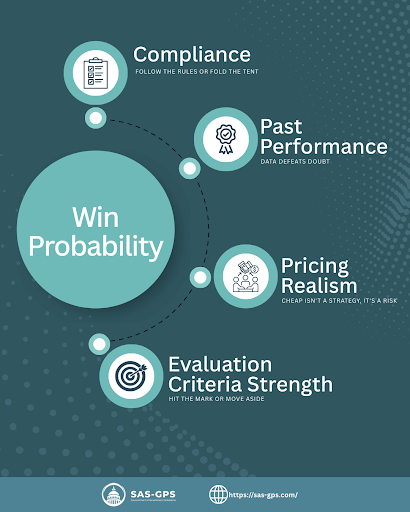
A disciplined PWIN analysis evaluates:
- Alignment with disclosed evaluation criteria
- Compliance posture
- Past performance relevance and risk
- Competitive positioning
- Pricing strategy and realism exposure
Under FAR Part 15, agencies must disclose evaluation factors and their relative importance in the solicitation (FAR 15.304), and proposals are evaluated strictly against those criteria (FAR 15.305). The evaluation logic is not hidden. It is formally documented in the request for proposal.
That structure provides the foundation for credible PWIN consulting and go/no-go decisions. Probability is not abstract. It is tied directly to evaluation mechanics.
Evaluation Structure Defines Win Probability
Win probability increases when proposal strengths directly align with disclosed evaluation factors.
Strengths that are not mapped to evaluation criteria carry limited weight in source selection. Conversely, clearly documented discriminators aligned with technical, management, past performance, and price factors materially affect competitiveness.
A structured win probability analysis translates solicitation language into measurable positioning questions:
- Do we have relevant, recent past performance aligned to scope and complexity?
- Can we substantiate technical strengths tied directly to evaluation factors?
- Are we positioned favorably against likely competitors?
- Is our pricing strategy aligned to the procurement structure?
Without this alignment, probability estimates become subjective.
Compliance Certainty and Threshold Eligibility
Mandatory requirements establish eligibility. Certifications, representations, security clearances, formatting instructions, submission procedures, and socioeconomic eligibility conditions are not discretionary.
Failure to comply can eliminate a proposal from consideration regardless of technical merit.
Compliance certainty directly impacts PWIN
Organizations frequently underestimate compliance risk during early pursuit decisions. A structured compliance review, supported by an RFP compliance checklist or matrix, should precede major resource allocation..
Past Performance and CPARS Risk
Under FAR 15.305(a)(2), agencies evaluate the recency, relevance, and quality of an offeror’s past performance. CPARS and other documented performance records inform risk evaluation.
Internal belief in capability is not equivalent to documented relevance.
When prior contracts do not closely resemble the scope, environment, contract type, or complexity of the solicitation, win probability decreases, even when technical talent exists internally.
Disciplined PWIN services incorporate objective past performance analysis rather than relying on generalized capability narratives.
Price to Win: More Than Just Being Low
Pricing strength is not synonymous with offering the lowest price.
Under FAR 15.404-1, agencies may evaluate price reasonableness and, in certain procurements, cost realism. Unrealistic pricing reduces credibility and increases perceived performance risk.
This is where price-to-win analysis becomes central.
A structured government price-to-win approach evaluates:
- Likely competitor labor structures
- Historical award data
- Agency budget constraints
- Contract type and evaluation methodology
- Technical solution alignment to cost assumptions
Effective price-to-win analysis ensures pricing is competitive, defensible, and aligned with the proposed solution. It reduces the risk of both underpricing (and exposing performance risk) and overpricing (and losing competitiveness).
For $1M+ bids, pricing strategy is a important driver of win probability.
Competitive Positioning and Relative Probability
Win probability is relative.
A technically strong proposal may still carry a low PWIN if:
- An incumbent possesses highly relevant performance history
- A competitor has exclusive past performance alignment
- A small business set-aside or other contractor preference shift evaluation weighting
- The procurement structure favors a particular contract holder
Effective PWIN consulting incorporates competitive landscape analysis. Probability cannot be assessed in isolation. It must be measured against realistic competitive scenarios.
Avoiding Optimism Bias in Go/No-Go Decisions
One of the most common failures in go/no-go decisions is internal optimism bias.
Pre-solicitation engagement, positive agency feedback, or familiarity with the requirement may increase internal confidence without improving objective evaluation alignment.
Capability does not equal documented past performance relevance.
Intent does not equal compliance certainty.
Incumbent familiarity does not guarantee a scoring advantage.
If a perceived strength cannot be directly mapped to a disclosed evaluation factor, it should not materially influence win probability assessment.
Grounding go/no-go decisions in acquisition structure reduces subjectivity and strengthens executive governance.
From PWIN Analysis to Go/No-Go Authorization

For $1M+ federal pursuits, leadership should conduct structured go/no-go decision support incorporating:
- Degree of alignment with disclosed evaluation criteria
- Quality, recency, and relevance of past performance
- Price to win positioning and cost realism exposure
- Compliance certainty with mandatory requirements
- Competitive positioning supported by identifiable discriminators
When measurable strengths align with evaluation logic and material weaknesses can be mitigated prior to submission, a go decision is supported by evidence.
When gaps cannot be credibly closed before delivery, a disciplined no-go decision preserves capital, protects proposal bandwidth, and reduces indirect cost exposure.
PWIN analysis functions as an internal governance tool, translating evaluation mechanics into executive authorization discipline.
Documentation and Accountability
Under FAR 15.308, agencies must document source selection decisions. Contractors are not legally required to replicate that structure internally, but disciplined organizations often maintain written rationales for major pursuit decisions.
Documented probability assessments:
- Reduce decision variability
- Improve capture discipline
- Support post-award lessons learned
- Strengthen accountability for resource allocation
Governance around pursuit authorization reduces reactive bidding and improves long-term portfolio management.
When to Engage PWIN Consulting Support
Organizations typically seek external PWIN consulting or proposal strategy consulting support when:
- Pursuing higher-value contracts than usual
- Expanding into new agencies or contract vehicles
- Entering competitive GWAC or IDIQ environments
- Facing pricing realism exposure
- Scaling beyond informal capture processes
External review introduces objectivity, mitigates optimism bias, and strengthens executive confidence in go/no-go decisions.
Conclusion
Federal awards are determined through structured evaluation governed by regulation and clearly disclosed solicitation criteria. Contractors cannot alter the evaluation framework. They can, however, control how rigorously internal pursuit decisions align with that framework.
For $1M+ opportunities, disciplined PWIN analysis and a price-to-win strategy reduce financial exposure, improve the allocation of proposal resources, and elevate go/no-go decisions from informal judgment calls to documented governance actions.
PWIN is not a marketing metric. It is a structured decision framework grounded in acquisition procedure and competitive positioning.
When implemented responsibly, it transforms reactive bidding into strategic growth.
How SAS-GPS Supports PWIN and Go/No-Go Strategy
SAS-GPS integrates structured PWIN analysis, price-to-win modeling, and go/no-go decision support into its federal proposal development and capture management services.
Our approach evaluates:
- Evaluation factor alignment under FAR Part 15
- Competitive positioning and discriminator strength
- Past performance relevance and CPARS risk
- Pricing defensibility and realism exposure
- Compliance posture across mandatory requirements
This disciplined pre-pursuit assessment helps leadership allocate proposal resources to opportunities with defensible win probabilities, not simply high revenue potential.
If your organization is preparing for a significant federal bid and requires disciplined evaluation alignment before committing full proposal resources, SAS-GPS integrates structured probability assessment into our federal proposal writing and development services.
Learn more about our federal proposal writing and proposal development services and how disciplined capture strategy and pricing alignment strengthen go or no-go decisions before submission.