| Quick Answer: What Is GSA Schedule Consulting? |
| GSA Schedule consulting is a professional service that helps federal contractors prepare, submit, and manage a Multiple Award Schedule (MAS) contract through the General Services Administration (GSA). Consultants guide contractors through eligibility assessment, offer preparation, price negotiation, and post-award compliance to maximize the value of their Schedule contract. |
The GSA Multiple Award Schedule (MAS) program is the federal government’s primary vehicle for purchasing commercial products and services. According to GSA, the program exceeded $50 billion in total sales in FY 2025, with more than 14,500 contractors holding active Schedule contracts. For federal contractors, getting on the Schedule creates direct access to agencies across the government without requiring a separate competitive bid for every opportunity.
But a GSA Schedule contract is not a simple application. The offer process is technical, the pricing negotiations are consequential, and the post-award compliance obligations are ongoing. That is why many contractors work with a federal proposal writing and development team that understands the MAS process from eligibility through award and can keep the effort on track from day one.
This article explains what GSA Schedule consulting covers, when it makes sense to bring in outside expertise, and what contractors risk by navigating the process without professional support.
What Is a GSA Schedule (And Why It Matters for Growth)
A GSA Multiple Award Schedule (MAS) contract is a long-term, government-wide contract that allows federal agencies to purchase commercial goods and services at pre-negotiated prices. Under FAR Subpart 8.4, ordering agencies can use Schedules to fulfill requirements quickly without running a full competitive procurement.
For contractors, the Schedule provides a streamlined path to federal customers, reduces acquisition friction for buyers, and establishes your pricing as fair and reasonable from the outset. IT and Professional Services are the dominant categories, together accounting for more than 60 percent of total MAS sales in FY 2025.
The program is also under active scrutiny. In March 2025, GSA announced it was targeting hundreds of Schedule holders for removal after failing to meet minimum sales thresholds, and eliminating dozens of Special Item Numbers (SINs) with insufficient market activity. Getting on the Schedule without a strategy to use it is increasingly untenable.
What Does a GSA Schedule Consultant Do?
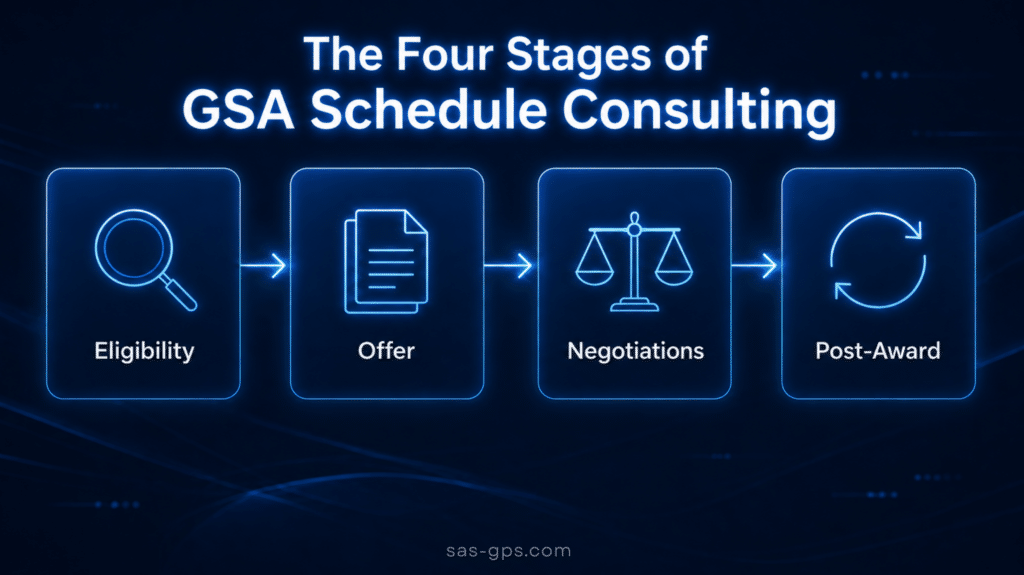
GSA Schedule consulting covers the full lifecycle of a MAS contract, from pre-offer planning through active post-award management. Here is what each phase typically involves.
Eligibility Assessment and Readiness Review
Before a contractor submits an offer, a consultant evaluates whether pursuit makes strategic sense. This includes reviewing the company’s services against available SINs, assessing past performance requirements, confirming that two years of financial data meet GSA’s standards, and determining whether the contractor has a realistic pipeline of agency customers who will actually use the Schedule once awarded.
Offer Preparation and Compliance
The offer package is where most first-time applicants lose time. It requires a completed offer submitted through eOffer, a pricing proposal with supporting commercial sales data, relevant past performance narratives, and documentation that meets GSA’s technical evaluation criteria for certain SINs. Errors in the pricing template or missing compliance documentation trigger clarification requests that can extend the review process significantly.
Pricing Negotiations
Unlike standard government contracts, GSA Schedule pricing is negotiated directly with GSA contracting officers before award. The objective is to establish rates that are fair and reasonable. A consultant prepares the pricing narrative, develops the basis-of-estimate, and supports the negotiation to protect the contractor’s margin while satisfying GSA’s pricing standards.
Post-Award Compliance and Modifications
Holding a Schedule contract creates ongoing obligations. These include Transactional Data Reporting (TDR) requirements for many SINs, catalog management through GSA’s FAS Catalog Platform, price modifications when commercial rates change, and option period renewals. GSA also conducts periodic contractor performance reviews to verify that pricing, reporting, and sales activity meet contract requirements. Consultants help contractors prepare for those reviews, stay current on reporting obligations, and avoid the administrative gaps that can lead to contract cancellation.
When Does It Make Sense to Hire a GSA Schedule Consultant?
Not every contractor needs outside help. But for most small and mid-size businesses, the cost of consultant support is quickly offset by avoiding common delays, pricing errors, and post-award compliance gaps. Consider bringing in a consultant when any of the following apply.
- This is your first Schedule offer and you have not navigated the eOffer system or pricing templates before.
- Your services span multiple SINs and category alignment is unclear.
- You have received a clarification request from GSA and need help preparing a compliant response.
- You hold a Schedule but are not generating sales and do not know why.
- Your current MAS contract is up for an option period review and you want to ensure continuity.
- You are responding to a task order solicitation that requires Schedule-specific pricing and documentation.
How a GSA Schedule Fits Into a Broader Federal Strategy
The GSA MAS is a contract vehicle, meaning it gives agencies a pre-approved mechanism to buy from you. It creates access, but it does not generate revenue on its own. Contractors who treat the MAS award as the finish line often find themselves holding an active contract with little agency engagement.
A GSA Schedule should sit inside a broader capture planning strategy that identifies target agencies, establishes relationships with contracting offices, and maps the Schedule to specific upcoming task order solicitations. The Schedule becomes most valuable when a contractor already knows which agencies it wants to serve and is using the vehicle to simplify the transaction. That also means actively monitoring eBuy and agency procurement forecasts, and making deliberate decisions about which task order solicitations to pursue.
This is why an eligibility assessment from a consultant focuses on pipeline fit, not just documentation readiness. A well-positioned offer is the result of a contractor who knows where the orders will come from.
Common Mistakes Contractors Make Without Professional Support
The following errors are consistent patterns in Schedule applications and post-award management that experienced consultants help contractors avoid.
- Pricing misalignment. Submitting rates that are not consistent with commercial sales data, or that cannot be supported under GSA’s pricing analysis methodology, leads to extended negotiations or offer rejection.
- SIN selection errors. Choosing Special Item Numbers that do not accurately reflect the contractor’s core offerings limits discoverability on GSA Advantage and reduces the volume and quality of inbound task order opportunities.
- Catalog management gaps. Failing to keep the contract catalog current in the FAS Catalog Platform (GSA’s modernized catalog system) can result in items being unavailable to buyers or non-compliant with GSA’s current template requirements, which were updated significantly in 2025.
- Missing sales thresholds. GSA requires contractors to meet minimum sales criteria to retain their Schedule contract. Contractors who win the vehicle without a clear utilization plan risk removal during GSA’s periodic compliance reviews.
- Neglecting modifications. Commercial pricing changes, new service offerings, and staffing additions all require contract modifications. Letting modifications lapse creates gaps between what the contractor can deliver and what the contract authorizes.
From Schedule Award to Proposal Execution
A GSA Schedule supports task order competitions, not open-market bids. Once on the Schedule, contractors still need to compete for individual task orders. Agencies issue Requests for Quotes (RFQs) through eBuy or other platforms, and Schedule holders respond with proposals.
Winning task orders requires the same rigor as any other federal proposal: technical narrative quality, past performance alignment, and a pricing response that reflects the Schedule rates while remaining competitive. Many contractors with active Schedules underperform on task orders because their proposal development process does not match the quality of their offer preparation.
If your pipeline includes active GSA task order opportunities, working with a team experienced in proposal strategy and development ensures the effort invested in securing your Schedule translates into actual awards.
Frequently Asked Questions
How long does it take to get a GSA Schedule with consultant support?
The GSA MAS offer process typically takes three to six months from initial submission to award, depending on the complexity of the offer, the number of SINs, and the pace of GSA’s review and negotiation process. Consultants help reduce this timeline by submitting complete, compliant offers and responding quickly to clarification requests.
Is GSA Schedule consulting worth the cost for a small business?
For contractors with a clear pipeline of agency customers who use the Schedule as their preferred acquisition vehicle, the answer is generally yes. The cost of a rejected or poorly structured offer, including rework time and delayed revenue, typically exceeds the cost of professional support. The more important question is whether a Schedule is the right vehicle at all, which is itself a question a consultant can help answer. It is also worth noting that a growing share of federal purchases are being channeled through vehicles like the GSA MAS rather than run as standalone open-market competitions. Agencies use Schedules precisely because it reduces their acquisition burden. Contractors without a Schedule can find themselves locked out of opportunities that never appear on SAM.gov as open solicitations.
Can a contractor lose their GSA Schedule?
Yes. GSA can cancel Schedule contracts for failure to meet minimum sales thresholds, compliance violations, or performance issues. In 2025, GSA announced an active effort to remove hundreds of contractors who had not met sales criteria, as part of a broader program to improve efficiency and reduce administrative overhead. Contractors who hold a Schedule must actively market it and maintain compliance to retain the contract.
Key Takeaways
| Key Takeaways |
| The GSA MAS program exceeded $50 billion in total sales in FY 2025, making it the largest commercial acquisition program in the federal government. |
| A GSA Schedule is a long-term contract vehicle, not a one-time award. Post-award compliance, modifications, and active marketing are ongoing obligations. |
| Consultants add the most value in offer preparation and pricing negotiations, where errors or misalignments most commonly cause rejection or low contract utilization. |
| GSA is actively removing Schedule holders who do not meet minimum sales thresholds. Getting on the Schedule without a utilization strategy is a wasted investment. |
| GSA Schedule consulting is most valuable for contractors who have identified a clear pipeline of agency customers and need the vehicle to access them efficiently. |
Work With a Federal Proposal Team That Wins
Whether you have an RFP in hand today, are pursuing a GSA Schedule or other contract vehicle, or are building your federal strategy for the year ahead, SAS-GPS is ready to help. We provide end-to-end proposal development, compliance review, pricing support, and contract vehicle pursuit strategy for federal contractors across all industries.
Learn more about our government proposal writing services or contact our team to discuss an active opportunity.
Sources
GSA MAS Contract Sales FY 2025 — gsa.federalschedules.com
GSA to Rightsize Multiple Award Schedule Program — gsa.gov
Requirements After Getting a MAS Contract — gsa.gov
Multiple Award Schedule Program — gsa.gov
FAR Subpart 8.4 — Federal Supply Schedules — acquisition.gov
GSA Small Business MAS Sales FY 2024 — gsa.federalschedules.com