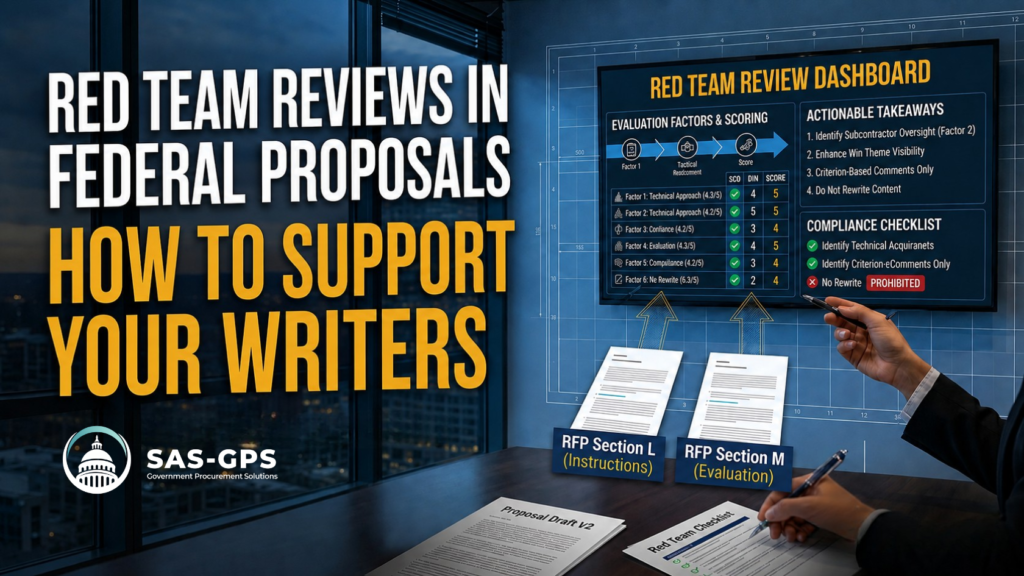
| Quick Answer: What Is a Red Team Review? A federal proposal red team review is a structured evaluation of a proposal draft against the solicitation’s evaluation criteria. Its purpose is to identify compliance gaps, weak narratives, and areas where the proposal fails to communicate the offeror’s strengths clearly to an evaluator. It is not a proofreading session. |
What a Red Team Review Is Actually For
A red team review is a structured evaluation of a proposal draft against the solicitation’s evaluation criteria. Its purpose is to identify gaps in compliance, weak technical or management narratives, and areas where the proposal fails to clearly communicate the offeror’s strengths to an evaluator.
It is not a final copyedit. It is not an opportunity for leadership to rewrite what proposal writers have already built. It is a strategic checkpoint designed to answer one question: would an evaluator reading this proposal give it the highest possible score, and if not, why?
Where It Fits in the Proposal Timeline
The red team review typically occurs after the first or second complete draft has been produced. At this stage, all major sections should be populated and the proposal should be coherent enough to evaluate as a whole. Running the review earlier often means reviewers are commenting on incomplete content. Running it later leaves no time to act on the findings.
Most proposal schedules place the red team review roughly one to two weeks before the final submission deadline. The exact timing depends on the opportunity’s complexity and page volume, but the critical rule is this: the review must occur early enough for the team to make substantive changes.
Why It Fails When Treated as a Proofreading Pass
Reviewers who focus on sentence structure, word choice, or stylistic preferences are not helping the proposal. They are consuming time that writers need to address real compliance and strategy gaps. A red team that returns a document covered in tracked-change rewrites, rather than scored feedback against evaluation criteria, leaves proposal writers in a worse position than before the review.
The standard for useful red team feedback is simple: does this comment help the proposal score higher with the government? Every comment should trace back to an evaluation factor.
What Your Proposal Writers Actually Need From a Red Team
Proposal writers spend weeks inside a document. By the time the red team convenes, they are often too close to the content to see its weaknesses clearly. That is precisely what the review is for, but only if reviewers bring the right perspective.
What makes a reviewer useful is not seniority or subject matter expertise alone. It is the ability to approach the proposal as a stranger would: an evaluator who has never met your company, is reading dozens of proposals, and is scoring each one against a defined rubric.
What Do Writers Need Reviewers to Do?
Writers need reviewers to read against the RFP. Section L (Instructions to Offerors) tells offerors what to submit and how to format it. Section M (Evaluation Factors for Award) tells evaluators how to score it. Reviewers who have not read both sections before the review are not prepared to give feedback that moves the needle.
Writers also need feedback that is specific and actionable. “This section needs more detail” is not useful. “This section does not address how you will manage subcontractor oversight under Factor 2, which is weighted Highly Important” is. The difference between those two comments is the difference between a writer knowing what to fix and a writer guessing.
What Do Writers Not Need From a Red Team?
Reviewers who rewrite passages are not reviewing; they are editing. Even well-intentioned rewrites can strip out compliance language, change technical accuracy, or introduce a voice inconsistent with the rest of the document. Reviewers should flag, score, and recommend. Writers should fix.
How to Structure a Red Team Review That Works
Running an effective red team review requires preparation before the session, discipline during it, and a clear handoff after it.
Who Should Be in the Room
The most effective red teams include:
- A reviewer who has not been involved in writing the proposal, to provide a fresh perspective
- Someone familiar with the agency or program office, who can evaluate whether the proposal speaks to the customer’s known priorities
- A subject matter expert for each major technical area, focused only on accuracy and completeness, not prose
- A capture or business development lead who can assess whether the win strategy is visible in the narrative
Not every pursuit justifies a large review panel. Scaling primes with smaller teams can run an effective red team with two or three reviewers, provided those reviewers evaluate distinct dimensions: compliance, technical strength, and competitive differentiation.
What Should Reviewers Be Evaluating?
Reviewers should work from a structured scorecard tied to the RFP’s evaluation criteria. For each factor, they should assess:
- Does the proposal directly address the requirement?
- Is the response clear enough for an evaluator unfamiliar with your company to understand?
- Does it demonstrate a clear discriminator, something that sets this offeror apart from likely competitors?
- Are there compliance gaps that would give an evaluator grounds to downgrade the score?
How Should Reviewers Deliver Feedback?
Feedback should be written, not verbal. Verbal-only red teams produce inconsistent takeaways and leave writers without a clear record of what needs to change.
Each comment should:
- Reference the specific section and RFP factor it addresses
- Describe the problem clearly
- Recommend a direction for the fix, not rewrite the fix itself
Teams that use a structured review form rather than free-form document comments tend to produce more consistent, actionable findings. For teams building out their capture planning process in government contracting, incorporating a formal review protocol early is one of the highest-leverage improvements available.
Common Red Team Mistakes That Hurt Proposals
Even experienced teams fall into patterns that reduce the review’s value. The most damaging are:
Rewriting Instead of Reviewing
When a reviewer rewrites a passage, they often do so based on their own writing preferences rather than evaluation criteria. Proposal writers who receive a document full of tracked rewrites must now reconcile two voices, verify that compliance language was preserved, and rebuild sections that may have been structurally sound. The review has added work, not clarity.
Reviewing Without the Evaluation Criteria in Hand
A reviewer who has not read Section M of the solicitation cannot evaluate whether the proposal addresses what matters most to the government. Evaluation criteria are the only lens that counts. Reviewers should have Section L and Section M open, or a prepared summary of evaluation factors and their relative weights, throughout the review session.
Waiting Too Late to Start
A red team review that occurs three days before submission gives writers no meaningful time to act on findings. By that point, the team is in final production mode and major structural changes are not feasible. The review either gets ignored or causes a scramble that introduces new errors.
The red team should be a mid-process checkpoint, not a final safety net.
A Red Team Review Checklist for Scaling Teams
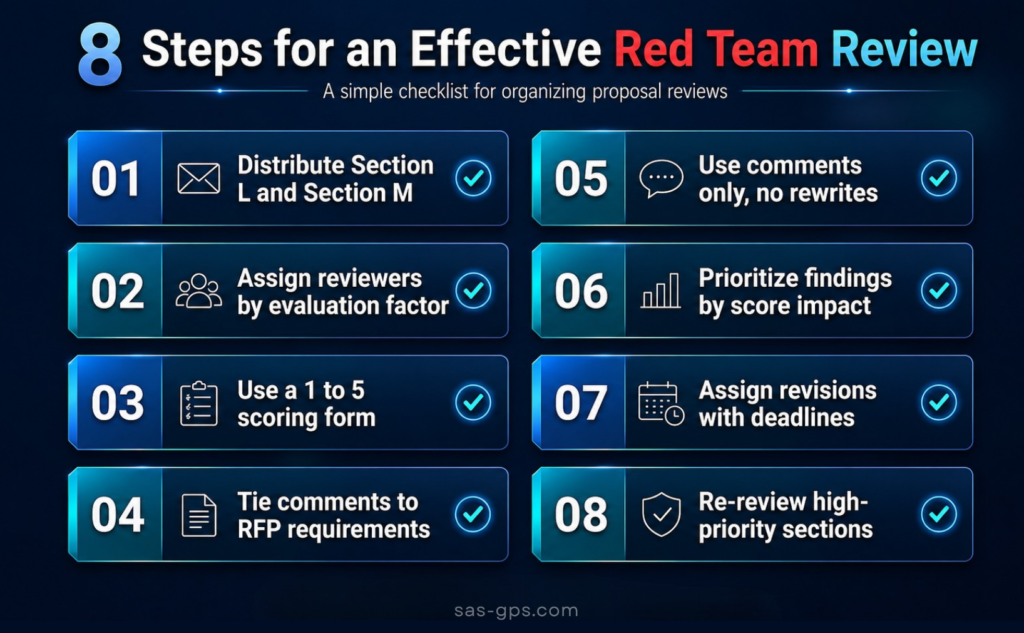
For teams running a red team with limited staff, this checklist provides a starting framework. Each item maps to a common point of failure:
- Distribute Section L and Section M to all reviewers before the session
- Assign each reviewer a specific evaluation factor, not the whole proposal
- Use a standard scoring form (1 to 5 scale per factor, with written comments required)
- Set a rule: comments must reference a specific RFP requirement or evaluation criterion
- Prohibit in-document rewrites; use comments only
- Debrief as a group to prioritize findings by impact on score
- Assign every finding to a specific writer with a revision deadline
- Schedule a brief re-review of high-priority sections after revisions are made
This structure works for a two-person review as well as a ten-person panel. The discipline of the process matters more than the size of the team.
| Key Takeaways: A red team review evaluates proposal compliance and strategy against the RFP’s evaluation criteria. It is not a proofreading session. Reviewers must read Section L and Section M before the review and score each evaluation factor with written, actionable comments. Writers need specific, criterion-based feedback, not rewrites or style edits. The review must occur early enough for the team to make substantive revisions before submission. Small teams can run effective red teams by assigning reviewers to specific factors and using a structured scoring form. |
Work With a Federal Proposal Team That Wins
Whether you have an RFP in hand today or you are building your federal strategy for the year ahead, SAS-GPS is ready to help. We provide end-to-end proposal development, compliance review, and pricing support for federal contractors across all industries.
Learn more about our government proposal writing services or contact our team to discuss an active opportunity.
Sources
Federal Acquisition Regulation (FAR), Subpart 15.2: https://www.acquisition.gov/far/subpart-15.2
SBA Federal Contracting: https://www.sba.gov/federal-contracting